
 It is a bit presumptuous to think I could reduce the universe of mathematics to some succinct essence, but ever since I first saw a column in Martin Gardner’s Scientific American Mathematical Games in 1967, I thought his example illustrated the essential feature of mathematics, or at least one of its principal attributes. And he posed it in a way that would be accessible to anyone. I especially wanted to credit Martin Gardner, since the idea resurfaced recently, uncredited, in some attractive videos by Katie Steckles and James Grime. (This reminds me of the Borges idea that “eighty years of oblivion are perhaps equal to novelty”.) See the Essence of Mathematics.
Author Archives: Jim Stevenson
February 29
 Being born on February 29 I have always had an interest in the calendar and the mechanics of Leap Year. Since I am sure everyone knows about Leap Year, I will just rattle off a few trivia questions to stimulate the memory. Why was I excited about my birthday in 2000 when everyone knew it was a Leap Year, being 4 years after 1996? When I lived in Brazil, everyone referred to Leap Year as bissextile. What was that all about? After the Gregorian reform in 1582, how come George Washington’s mother recorded his birth in their family bible as 11 February 1731 when we say it is 22 February 1732 (whereas Abraham Lincoln’s mother recorded 12 February 1809 for her son, which we agree with)? See February 29.
Update (2/29/2020) Continue reading
Feedback Request
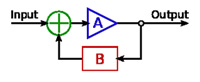 I have almost completed my original goal of publishing articles I have written to myself over the last several years regarding matters mathematical (together with a sprinkling of more recent items). From the visit counts I can tell someone is reading them, but other than spam from porn and gambling sites and intrusions from Russian bots, I have received no feedback on the material in comments, nor via the more private venue of email: mathmeditations@josmfs.net.
Certain mysteries have arisen, such as the enormous hits on the Pool Party posting, whereas the More Pool post in a similar vein has received much less attention. I can guess the interest in the Three Jugs Problem and Three Jugs Problem Redux may have stemmed from the Bing and DuckDuckGo search results, but the Pool Party remains a mystery.
Even though I get a kick out of producing these articles for my own satisfaction, I wouldn’t mind hearing more views on my solutions and commentary, since I am quite rusty on these matters and welcome questions, corrections, and clarifications. I am also curious about further topics and postings I might consider. It seems that the Puzzles and Problems receive the most visits, whereas my own Curiosities and Questions the least, and the Math Inquiries somewhere in between. I have a few more ideas I might explore, but would welcome any suggestions that are within my ability to address.
Bugles, Trumpets, and Beltrami
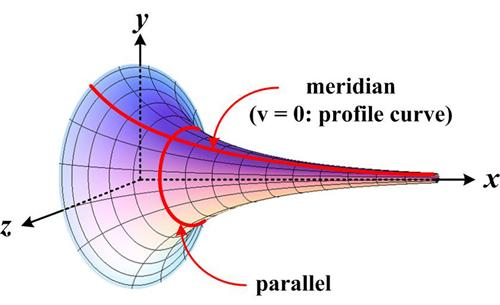 This essay began as an effort to prove Tanya Khovanova’s statement in her article “The Annoyance of Hyperbolic Surfaces” that her crocheted hyperbolic surface had constant (negative) curvature. I discussed Khovanova’s article in my previous essay “Exponential Yarn”. What I thought would be a fairly straight-forward exercise turned into a more concerted effort as I concluded that her crocheted surface did not have constant curvature. However, I found additional references that supported her statement, so I was becoming quite confused. I looked at other, similar surfaces to try to understand the whole curvature situation. This involved a lot of tedious computations (with my usual plethora of mistakes) that proved most challenging. But then I realized where I had gone astray. To cover my ignorance I claimed my error stemmed from a subtle misunderstanding. Herewith is a presentation of what I found. See Bugles, Trumpets, and Beltrami.
(Update 4/6/2019) Continue reading
Exponential Yarn
 Tanya Khovanova’s recent blog post “The Annoyance of Hyperbolic Surfaces” about crocheting a hyperbolic surface added to the numerous examples of such activity, usually from knitting. Somehow this post caught my attention, in particular about the exponential growth of each added row and the fact that the resulting “surface” had constant negative curvature. I explored the exponential growth in this article and saved the mathematical exploration of the constant negative curvature for a later essay. See Exponential Yarn.
Lorentz Transformation
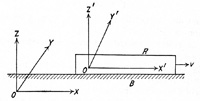 Over the years one of the subjects I return to periodically to study is Einstein’s Theory of Relativity, both the Special and General theories. Interest in the Special Theory focused on the derivation of the Lorentz transformations (or contractions). Why did objects appear with different lengths and clocks run at different speeds for observers moving relative to one another? Early on (late 60s) I came across a great explanation in the 1923 book by C. P. Steinmetz. He derived it from two general assumptions of special relativity: (1) that all motion is relative, the motion of the railway train relative to the track being the same as the motion of the track relative to the train, and (2) that the laws of nature, and thus the velocity of light, are the same everywhere. I did not follow his derivation completely, so I produced my own, which I will give here. See the Lorentz Transformation.
Star Sum of Angles
 This problem posted by Presh Talwalkar offers a variety of solutions, but I didn’t quite see my favorite approach for such problems. So I thought I would add it to the mix.
“Thanks to Nikhil Patro from India for suggesting this! What is the sum of the corner angles in a regular 5-sided star? What is a + b + c + d + e = ? Here’s a bonus problem: if the star is not regular, what is a + b + c + d + e = ?”

See Star Sum of Angles for solutions.
Leaning Squares
 This was a nice geometric problem from Poo-Sung Park @puzzlist posted at the Twitter site #GeometryProblem.
“Geometry Problem 65: Given one square leaning on another, what is the ratio of the triangular areas A:B?”

See the Leaning Squares for a solution.
More Pool
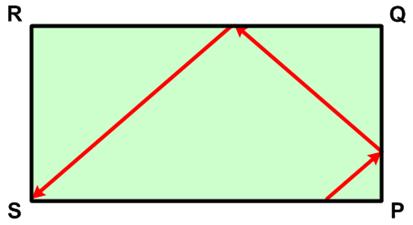 This is another UKMT Senior Challenge problem, this time from 2006.
“A toy pool table is 6 feet long and 3 feet wide. It has pockets at each of the four corners P, Q, R, and S. When a ball hits a side of the table, it bounces off the side at the same angle as it hit that side. A ball, initially 1 foot to the left of pocket P, is hit from the side SP towards the side PQ as shown. How many feet from P does the ball hit side PQ if it lands in pocket S after two bounces?”
Pool Partiers should have no difficulty solving this.

See More Pool for solutions.
Square Wheels
 I came across the following problem from an Italian high school exam on the British Aperiodical website presented by Adam Atkinson:
“There have been various stories in the Italian press and discussion on a Physics teaching mailing list I’m accidentally on about a question in the maths exam for science high schools in Italy last week. The question asks students to confirm that a given formula is the shape of the surface needed for a comfortable ride on a bike with square wheels.
What do people think? Would this be a surprising question at A-level in the UK or in the final year of high school in the US or elsewhere?”
I had seen videos of riding a square-wheeled bicycle over a corrugated surface before, but I had never inquired about the nature of the surface. So I thought it would be a good time to see if I could prove the surface (cross-section) shown would do the job. See Square Wheels.
(Update 9/14/2023) Square Bridge That Rolls!
 This is an incredible application of the rolling square wheels idea described on Matt Parker’s Stand-up Maths Youtube website. It also demonstrates the difference between engineering and pure math. The engineers had to solve some challenging problems to adapt the theoretical math to a practical application. And such solutions are always required under tight time constrictions. Engineering certainly is a noble profession.