
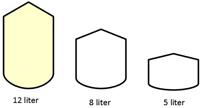
 I was sifting back through some problems posed by Presh Talwalkar on his website Mind Your Decisions, when I found another 3 Jugs problem, which was amenable to the skew billiard table solution from my earlier Three Jugs Problem. Here is his statement:
“A milkman carries a full 12-liter container. He needs to deliver exactly 6 liters to a customer who only has 8-liter and a 5-liter containers. How can he do this? No milk should be wasted: the milkman needs to leave with 6 liters of milk. Can he measure all amounts of milk from 1 to 12 (whole numbers) in some container?”
I also believe I found a case where Talwalkar’s solution to the last question needs revision. See the Three Jugs Problem Redux for solutions.
 This was a rather intricate puzzle from Presh Talwalkar. I found his solution a bit hard to follow, so I tried for a clearer presentation.
 This is another interesting problem from
  This problem from
  These are three “Coffin” Problems posed by Nakul Dawra on his Youtube site
  From
From  This is another problem from
  This subject admittedly has only a tenuous relationship to mathematics (via arithmetic), but perhaps it can join more mathematically challenging political topics like voting and gerrymandering. In any case, I was stimulated to consider the idea of reapportioning the US Senate by the % US population of each state by an 8 December 2018 article in the Atlantic by former Congressman John Dingell, who advocated abolishing the Senate. I thought this a bit too Draconian and considered the percent population idea as a better compromise. It turned out I was not alone in having this (obvious) thought: I just came across a more extensive 2 January 2019 Atlantic article by Eric Orts that concurs with my idea about reapportionment of the Senate, discusses the legal ramifications in more detail, and echoes the benefits I mentioned as well as others. See
  This is another problem from the defunct Wall Street Journal Varsity Math Week column.
 In light of subsequent events it may be that being a politician requires its own set of skills, but this praise of his profession of engineering before he became president casts the unfortunate Herbert Hoover in a different light. My father brought this surprising excerpt from Hoover’s autobiography to my attention years ago. I have highlighted the part that is especially insightful. Unfortunately, the balance of the chapter praising an engineer’s involvement in government does not fare as well, given the author, though a subsequent engineer US president, whatever his shortcomings, was never faulted for his honesty and moral rectitude. See the


