
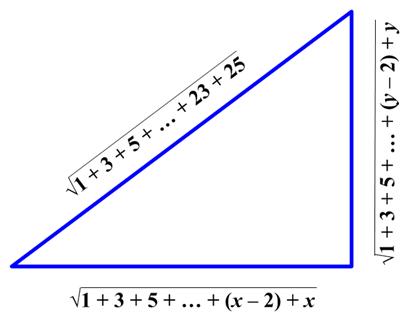
 This is an interesting problem from the United Kingdom Mathematics Trust (UKMT) Senior Math Challenge of 2008.
“The length of the hypotenuse of a particular right-angled triangle is given by √(1 + 3 + 5 + … + 23 + 25). The lengths of the other two sides are given by √(1 + 3 + 5 + … + (x – 2) + x) and √ (1 + 3 + 5 + … + (y – 2) + y) where x and y are positive integers. What is the value of x + y?”
See the Right Triangle with Roots for a solution.
 This turns out to be a fairly challenging driving problem from Longley-Cook.
 When our daughter-in-law made wheat shocks as center-pieces for hers and our son’s fall-themed wedding reception, I naturally could not help pointing out the age-old observation that they represented a hyperboloid of one sheet. This was naturally greeted with the usual groans, but the thought stayed with me as I realized I had never proved this mathematically to myself. And so I did.
 Here is another Presh Talwalkar problem that seems unsolvable at first glance.
 This is a great puzzle by H. E. Dudeney involving a very useful technique.
 Futility Closet offers another interesting puzzle:
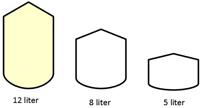 I was sifting back through some problems posed by Presh Talwalkar on his website
  This was a rather intricate puzzle from Presh Talwalkar. I found his solution a bit hard to follow, so I tried for a clearer presentation.
 This is another interesting problem from
  This problem from


