
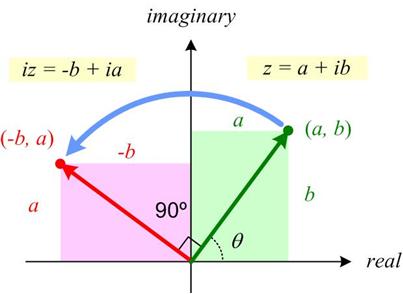
 This may be a futile attempt at an elementary introduction to complex variables by emphasizing their geometric properties. The elementary part is probably undermined by an initial discussion of field extensions and a necessary reference to trigonometry. Hopefully, the suppression of the explicit use of complex powers of Euler’s constant e until the very end will allow the geometric ideas to have center stage. A primary goal of the essay is to realize that complex polynomials involve sums of circles in the plane. The image of real polynomials as wavy curves in the plane is misleading for an understanding of complex behavior. See Complex Numbers – Geometric Viewpoint.
Perimeter-Area Problem
 James Tanton posted the following interesting problem on his Twitter account:
A square of area A, perimeter P. For which values 0< r <1 is there a line across the square that chops off rA of the area and rP of the perimeter as shown? (r = 1/2, yes; r = 1/3, no.)
See the Perimeter-Area Problem.
Meditation on “Is” in Mathematics II – Mathematical Reality
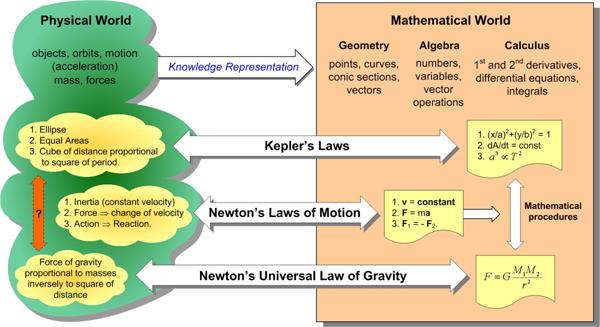 This post continues a meditation on the nature of mathematics begun in Part I. It involves the perennial question about whether mathematics is invented or discovered, and consequently evokes questions about mathematical reality. This subject is probably of little interest to most people, and even most mathematicians. But the extremely heavy involvement of mathematics in the descriptions of quantum mechanics, and the even more mathematically abstruse excursions into ideas such as string theory in an effort to wed quantum mechanics to general relativity, force us to confront the central place mathematics has in “explaining” our physical reality. Of course, this essay has no definitive answers, and leaves the situation as a mystery. See Meditation on “Is” in Mathematics II – Mathematical Reality.
Meditation on “Is” in Mathematics I – Zeno’s Paradox
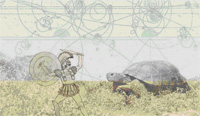 This post is the first on a meditation on the nature of mathematics as I see it. I have been thinking about this for some time, and my thoughts were again stimulated by a March 2014 article I read in Slate by Brian Palmer that attempted a popularized explanation of the mathematical concepts associated with Zeno’s Paradox. It was a laudable effort that I applaud. So it is a bit churlish of me to critique it, but I felt its misconceptions got at the heart of some fundamental ideas about mathematics that I wanted to clarify.
The key idea exemplified in this article is the role “making it up” plays in math. That is, the general impression seems to be that math is dealing with things as they actually are if we can just be brought to see it. Whereas the idea that mathematicians make things up or define things is given little credence. For example, 0 x 2 “is” 0 doesn’t make any sense if you arrive at multiplication inductively from the intuitive idea of its being repeated addition. That is, 2 x 0 = 0 + 0 = 0 makes sense, but 0 x 2 = 0 does not. So mathematicians just say let’s define 0 x 2 = 0. If we do, it will be consistent with the other rules we have abstracted from the repeated addition idea, such as the commutative and distributive rules – that is, nothing breaks. (Try defining 0 x 2 to be any other number than 0 and see what breaks.) To put it another way, the reason we want to have 0 x 2 = 0 is for a different reason than we originally thought was meant by multiplication. We have extended the original idea into new territory. A similar thing happens with the advent of negative numbers. This is a very sophisticated idea and a challenge to present at an elementary stage.
In Part I, I will first present the article, heavily annotated with my critique. Then in Part II I will try to explain in more depth the admittedly philosophical concepts I am trying to get at. See Meditation on “Is” in Mathematics I – Zeno’s Paradox.
Polygon Altitude Problems II
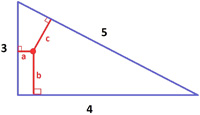 James Tanton has provided further elaborations on the polygons and the sum of perpendicular distances from interior points. Again I approached the solutions with a mix of areas and vectors. It is rather impressive to see the number of variations that can be rung on the Viviani Theorem theme. See Polygon Altitude Problems II
Polygon Altitude Problems I
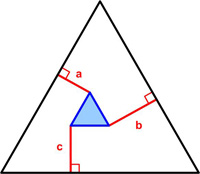 I found this collection of related problems by James Tanton on Twitter. Even though all these problems do not involve perpendiculars, they have a common solution approach – a sort of theme and variations idea. In a later tweet Tanton refers to a Viviani Theorem associated with these types of problems. I did not recall that theorem explicitly or by name. I also have not looked it up yet, in order to solve these problems on my own. I am guessing there is a more classical Euclidean geometry proof, but I like my vector approach for its clarity. I also throw in a bit a calculus at the end for fun. See Polygon Altitude Problems I
Geometric Puzzle Medley
 This is a collection of simple but elegant puzzles, mostly from a British high school math teacher Catriona Shearer, for which I thought I would show solutions (solutions for a number of them had not been posted yet on Twitter at the time of writing). See the Geometric Puzzle Medley.
Apparently Catriona Shearer creates these problems herself, which shows an especially gifted talent. Ben Olin, of Math with Bad Drawings fame, had an interesting interview with Ms. Shearer. The reason for the interest in her work becomes evident the more of her geometry problems one sees. They are especially elegant and minimalist, and often have simple solutions, as exemplified by the “5 Problem” or “Shear Beauty” problem illustrated here. Words, such as “beauty” and “elegance”, are often bandied about concerning various mathematical subjects, but as with any discussion of esthetics, the efforts at explanation usually fall flat. Shearer’s problems are one of the best examples of these ideas I have ever seen. If you contemplate her problems and even solve them, you will understand the meaning of these descriptions.
One of the key aspects of mathematics is often its “hidden-ness” (some would say “opacity” or “incomprehension”). Her problems appear to have insufficient information to solve. But as you look at the usually regular figures, you see that there are inherent rigid constraints that soon yield specific information that leads to a solution. This discovery is akin to the sensation of discovering Newton’s mathematical laws underlying physical reality. It is the essence of one of the joys of mathematics.
Perspective Map
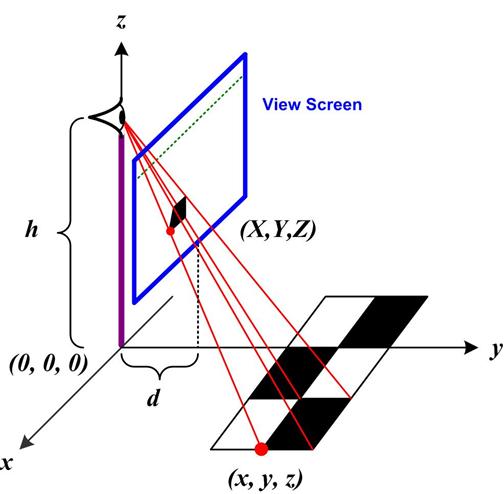 A number of recent puzzles have involved perspective views of objects. I had never really explored the idea of a perspective map in detail. So some of the properties associated with it always seemed a bit vague to me. I decided I would derive the mathematical equations for the perspective or projective map and see how its properties fell out from the equations. With this information in hand I then addressed some questions I had about the article “Dürer: Disguise, Distance, Disagreements, and Diagonals!” by Annalisa Crannell, Marc Frantz, and Fumiko Futamura concerning a controversy over Albrecht Dürer’s woodcut St. Jerome in His Study (1514). And finally, I read somewhere that a parabola under a perspective map becomes an ellipse, so I was able to show that as well. See the Perspective Map.
(Update 7/1/2019) Continue reading
Hossenfelder Stagnation Problem
 Sabine Hossenfelder wrote an excellent blog posting about the growing awareness that outstanding scientific problems are not getting solved at the same rate as in the past. Her whole article is worth a read, as are all her postings, but this latest contained a mathematical statement that warranted justification. For scientists “How much working time starting today corresponds to, say, 40 years working time starting 100 years ago. Have a guess! Answer: About 14 months.” See Hossenfelder Stagnation Problem.
Triangular Boundary Problem
 This problem comes from the defunct Wall Street Journal Varsity Math Week collection.
“The coach then shows the team the diagram to the left and asks: What is the maximum area of a rectangle contained entirely within a triangle with sides of 9, 10 and 17?”
I changed the numbers a bit to make my calculations easier, but left the problem otherwise unchanged. When I checked the Varsity Math Week solution, I saw they used a simplifying formula that I could not remember. I also believed their solution left out a justification for the maximal area. Besides an intuitive solution for this, I also included a calculus version.

See the Triangular Boundary Problem for solutions.