
This is problem #25 from the UKMT 2014 Senior Challenge.
“Figure 1 shows a tile in the form of a trapezium [trapezoid], where a = 83⅓°. Several copies of the tile placed together form a symmetrical pattern, part of which is shown in Figure 2. The outer border of the complete pattern is a regular ‘star polygon’. Figure 3 shows an example of a regular ‘star polygon’.
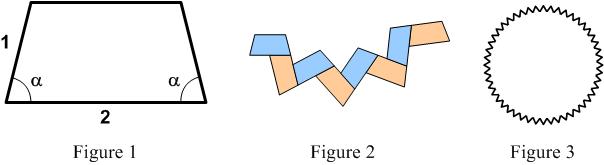 How many tiles are there in the complete pattern?
_____A_48_____B_54_____C_60_____D_66_____E_72”
See the Star Polygon Problem for solutions.
 This is another delightful H. E. Dudeney puzzle.
 In a June Chalkdust
  ”
” This is a tricky product problem from Alfred Posamentier which naturally has a slick solution—if you can think of it.
 Here is a problem from the UKMT Senior (17-18 year-old) Mathematics Challenge for 2012:
 This is a fun problem from Mathematical Quickies (1967).
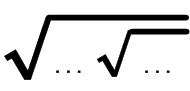 This is another UKMT Senior Challenge problem, but for the year 2005. I thought it was diabolical and hadn’t a clue how to solve it. Even after reading the solution, I don’t think I could have come up with it. I take my hat off to anyone who solves it.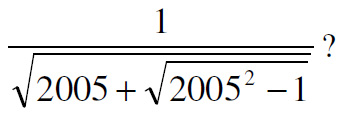

 This is a problem from the UKMT Senior Challenge for 2001. (It has been slightly edited to reflect the colors I added to the diagram.)
 Yet another train problem from H. E. Dudeney.
 Catriona Shearer retweeted the following problem from Antonio Rinaldi


