
 Here is a problem from the famous (infamous?) Putnam exam, presented by Presh Talwalkar. Needless to say, I did not solve it in 30 minutes—but at least I solved it (after making a blizzard of arithmetic and trigonometric errors).
“Today’s problem is from the 1978 test, problem B1 (the easiest of the second set of problems). A convex octagon inscribed in a circle has four consecutive sides of length 3 and four consecutive sides of length 2. Find the area of the octagon.”
My solution is horribly pedestrian and fraught with numerous chances for arithmetic mistakes to derail it, which happened in spades. As I suspected, there was an elegant, “easy” solution (as demonstrated by Talwalkar)—once you thought of it! Again, this is like a Coffin Problem.
See the Putnam Octagon Problem for solutions.
 This is one of H. E. Dudeney’s train puzzles.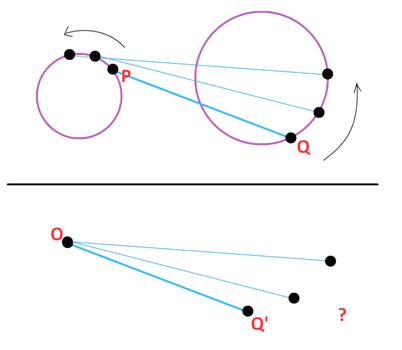
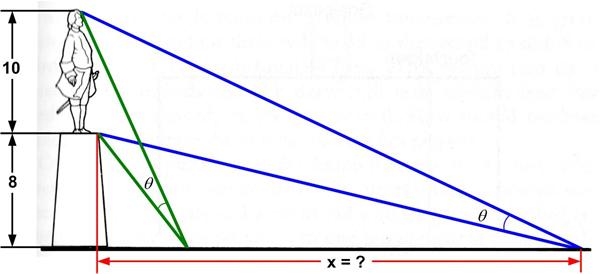 This is an old problem I had seen before. Here is David Wells’s rendition: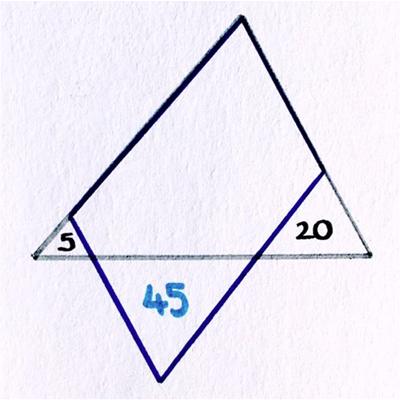
 Futility Closet presented a nifty method of solving the “counterfeit coin in 12 coins” problem in a way I had not seen before by mapping the problem into numbers in base 3. It wasn’t immediately clear to me how their solution worked, so I decided to write up my own explanation.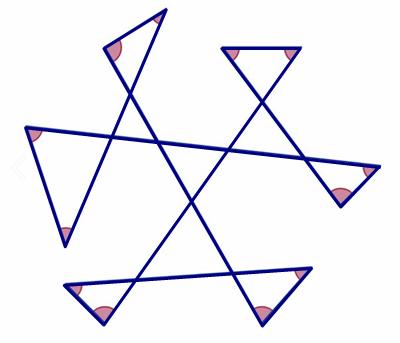
 Setting aside my chagrin that the following problem was given to pre-university students, I initially found the problem to be among the daunting ones that offer little information for a solution. It also was a bit “inelegant” to my way of thinking, since it involved considering some separate cases. Still, the end result turned out to be unique and satisfying (Talwalkar’s Note 2 was essential for a unique solution, since the problem as stated was ambiguous).
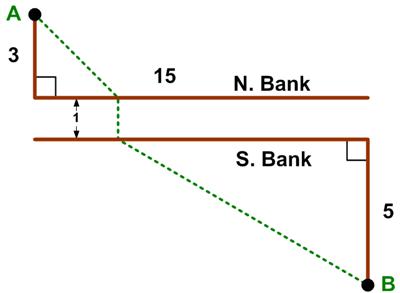 This is a riff on a classic problem, given in Challenging Problems in Algebra.
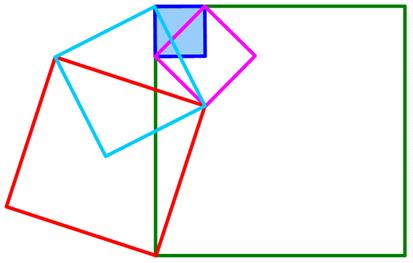 Here is another imaginative geometry problem from


