 An amazing publication was conceived primarily for women at the beginning of the 18th century in 1704 and was called The Ladies’ Diary or Woman’s Almanack. What made it even more remarkable was that each issue contained mathematical problems whose solutions from the readers were provided in the next issue. One particularly sharp woman was Mary Wright (Mrs. Mary Nelson). This is one of her problems:
“VIII. Question 72 by Mrs. Mary Nelson
(proposed in 1719, answered in 1720)
A prize was divided by a captain among his crew in the following manner: the first took 1 pound and one hundredth part of the remainder; the second 2 pounds and one hundredth part of the remainder; the third 3 pounds and one hundredth part of the remainder; and they proceeded in this manner to the last, who took all that was left, and it was then found that the prize had by this means been equally divided amongst the crew. Now if the number of men of which the crew consisted be added to the number of pounds in each share, the square of that sum will be four times the number of pounds in the chest: How many men did the crew consist of, and what was each share?”
What makes this problem nice is that it does have a clean answer, contrary to most of the problems in The Ladies’ Diary.
Answer.
See the Ladies’ Diary Problem for solutions.
(Update 5/6/2019) Continue reading →

 Another challenging problem from Presh Talwalkar. I certainly could not have solved it on a timed test at the age of 16.
 Here is a problem from the UKMT Senior (17-18 year-old) Mathematics Challenge for 2012:
 I really was trying to stop including
  This is another train puzzle from H. E. Dudeney, which is fairly straight-forward.
 Here is a problem from the UKMT Senior (17-18 year-old) Mathematics Challenge for 2009:
 Since everyone by now who has any interest has gone directly to Catriona Shearer’s Twitter account for geometric puzzles, I was not going to include any more. But this one with its one-step solution is too fine to ignore and belongs with the “5 Problem” as one of the most elegant.
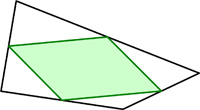 I came across this problem in Alfred Posamentier’s book, but I remember I had seen it a couple of places before and had never thought to solve it. At first, it seems like magic.
 Here is a problem from the famous (infamous?) Putnam exam, presented by Presh Talwalkar. Needless to say, I did not solve it in 30 minutes—but at least I solved it (after making a blizzard of arithmetic and trigonometric errors).
 This is one of H. E. Dudeney’s train puzzles.


