
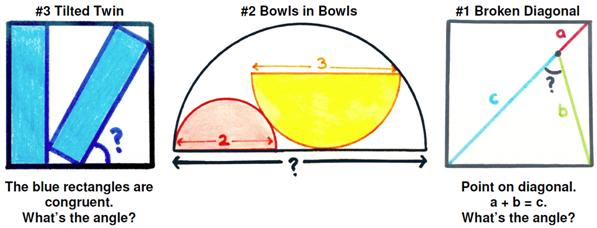
I was really trying to avoid getting pulled into more addictive geometric challenges from Catriona Shearer (since they can consume your every waking moment), but a recent post by Ben Orlin, “The Tilted Twin (and other delights),” undermined my intent. As Orlin put it, “This is a countdown of her three favorite puzzles from October 2019” and they are vintage Shearer. You should check out Olin’s website since there are “Mild hints in the text; full spoilers in the comments.” He also has some interesting links to other people’s efforts. (Olin did leave out a crucial part of #1, however, which caused me to think the problem under-determined. Checking Catriona Shearer’s Twitter I found the correct statement, which I have used here.)
I have to admit, I personally found the difficulty of these puzzles a bit more challenging than before (unless I am getting rusty) and the difficulty in the order Olin listed. Again, the solutions (I found) are simple but mostly tricky to discover. I solved the problems before looking at Olin’s or others’ solutions.
See the Geometric Puzzle Mayhem.
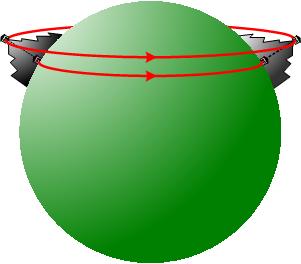 It is always fascinating to look at problems from the past. This one, given by Thomas Whiting himself, is over 200 years old from Whiting’s 1798 Mathematical, Geometrical, and Philosophical Delights:
 This is a problem from the UKMT Senior Challenge for 2001. (It has been slightly edited to reflect the colors I added to the diagram.)
 Catriona Shearer retweeted the following problem from Antonio Rinaldi
  Another challenging problem from
  I came across the following problem from an Italian high school exam on the British

 This is another interesting problem from
 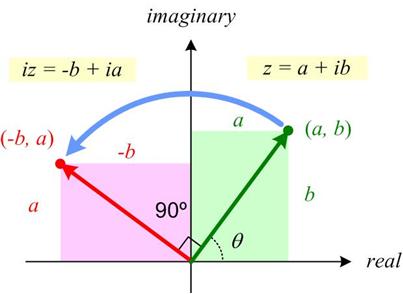 This may be a futile attempt at an elementary introduction to complex variables by emphasizing their geometric properties. The elementary part is probably undermined by an initial discussion of field extensions and a necessary reference to trigonometry. Hopefully, the suppression of the explicit use of complex powers of Euler’s constant e until the very end will allow the geometric ideas to have center stage. A primary goal of the essay is to realize that complex polynomials involve sums of circles in the plane. The image of real polynomials as wavy curves in the plane is misleading for an understanding of complex behavior. See
  This is a collection of simple but elegant puzzles, mostly from a British high school math teacher
 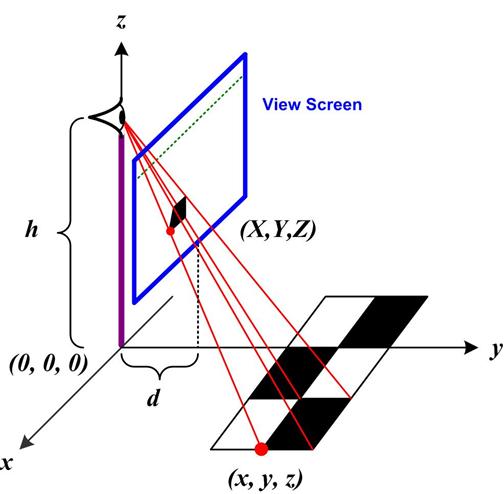 A number of recent puzzles have involved perspective views of objects. I had never really explored the idea of a perspective map in detail. So some of the properties associated with it always seemed a bit vague to me. I decided I would derive the mathematical equations for the perspective or projective map and see how its properties fell out from the equations. With this information in hand I then addressed some questions I had about the article “Dürer: Disguise, Distance, Disagreements, and Diagonals!” by Annalisa Crannell, Marc Frantz, and Fumiko Futamura concerning a controversy over Albrecht Dürer’s woodcut St. Jerome in His Study (1514). And finally, I read somewhere that a parabola under a perspective map becomes an ellipse, so I was able to show that as well. See the


