
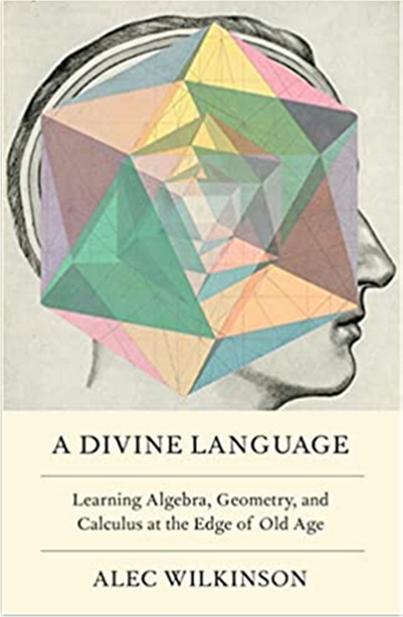
 I have just finished reading a most remarkable book by Alec Wilkinson, called A Divine Language: Learning Algebra, Geometry, and Calculus at the Edge of Old Age. I had read an essay of his in the New Yorker that turned out to be essentially excerpts from the book. I was so impressed with his descriptions of mathematics and intrigued by the premise of a mature adult in his 60s revisiting the nightmare of his high school experience with mathematics that I was eager to see if the book was as good as the essay. It was, and more.
The book is difficult to categorize—it is not primarily a history of mathematics, as suggested by Amazon. But it is fascinating on several levels. There is the issue of a mature perspective revisiting a period of one’s youth; the challenges of teaching a novice mathematics, especially a novice who has a strong antagonism for the subject; and insights into why someone would want to learn a subject that can be of no “use” to them in life, especially their later years.
Wilkinson has a strong philosophical urge; he wanted to understand the role of mathematics in human knowledge and the perspective it brought to life. He was constantly asking the big questions: is mathematics discovered or invented, what is the balance between nature and nurture, why does mathematics seem to describe the world so well, what is the link between memorization and understanding, how do you come to understand anything?
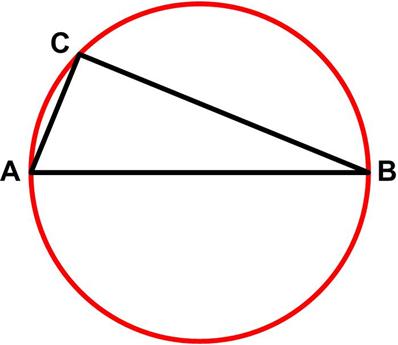 This math problem from Colin Hughes’s Maths Challenge website (mathschallenge.net) is a bit more challenging.
 Here is a tricky little logarithm problem from the 2021 Math Calendar.
 This is another candle burning problem, presented by
  Here is a challenging problem from the 2021 Math Calendar.
 This problem comes from the “Problems Drive” section of the Eureka magazine published in 1955 by the Archimedeans at Cambridge University, England. (“The problems drive is a competition conducted annually by the Archimedeans. Competitors work in pairs and are allowed five minutes per question ….”)
 Here is a challenging problem from the Polish Mathematical Olympiads published in 1960.
 This problem comes from the Scottish Mathematical Council (SMC) Senior Mathematical Challenge of 2008:
 Again we have a puzzle from the Sherlock Holmes puzzle book by Dr. Watson (aka Tim Dedopulos).
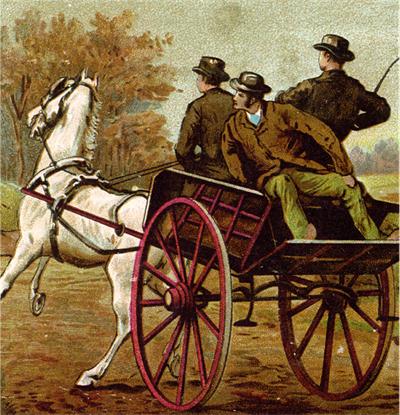 Here is another, more challenging, problem from the Sherlock Holmes puzzle book by Dr. Watson (aka Tim Dedopulos).


