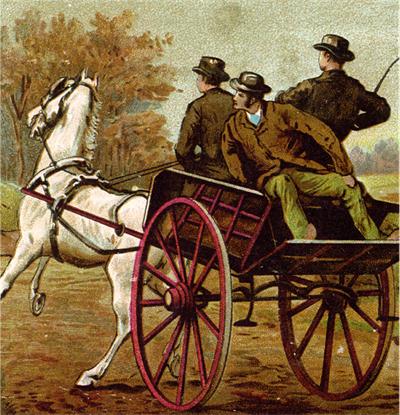
 Here is another, more challenging, problem from the Sherlock Holmes puzzle book by Dr. Watson (aka Tim Dedopulos).
“An event that occurred during The Adventure of the Wandering Bishops inspired Holmes to devise a particularly tricky little mental exercise for my ongoing improvement. There were times when I thoroughly appreciated and enjoyed his efforts, and times when I found them somewhat unwelcome. I’m afraid that this was one of the latter occasions. It had been a bad week.
‘Picture three farmers,’ Holmes told me. ‘Hooklanders. We’ll call them Ern, Ted, and Hob.’
‘If I must,’ I muttered.
‘It will help,’ Holmes replied. ‘Ern has a horse and cart, with an average speed of eight mph. Ted can walk just one mph, given his bad knee, and Hob is a little better at two mph, thanks to his back.’
‘A fine shower,’ I said. ‘Can’t I imagine them somewhat fitter?’
‘Together, these worthies want to go from Old Hook to Coreham, a journey of 40 miles. So Ern got Ted in his cart, drove him most of the way, and dropped him off to walk the rest. Then he went back to get Hob [who was still walking], and took him into Coreham, arriving exactly as Ted did. How long did the journey take?’
Can you find a solution?”
I added the statement in brackets. I initially thought Hob waited in Old Hook until Ted fetched him. But the solution indicated that was not the case. So I realized Hob had started out at the same time as the others. The solution has some hairy arithmetic. Even knowing the answer it is difficult to do the computations without a mistake.
Answer.
See the Old Hook Puzzle for solutions.

 This problem comes from the Scottish Mathematical Council (SMC) Senior Mathematical Challenge of 2008:
 Again we have a puzzle from the Sherlock Holmes puzzle book by Dr. Watson (aka Tim Dedopulos).
 The “
The “ Here is a simple problem from an old
  This typical problem from the prolific H. E. Dudeney may be a bit tricky at first.
 Here is a fairly straight-forward problem from 500 Mathematical Challenges.
 Here is another delightful problem from the Sherlock Holmes puzzle book by Dr. Watson (aka Tim Dedopulos).


