
 I came across the following problem from an Italian high school exam on the British Aperiodical website presented by Adam Atkinson:
“There have been various stories in the Italian press and discussion on a Physics teaching mailing list I’m accidentally on about a question in the maths exam for science high schools in Italy last week. The question asks students to confirm that a given formula is the shape of the surface needed for a comfortable ride on a bike with square wheels.
What do people think? Would this be a surprising question at A-level in the UK or in the final year of high school in the US or elsewhere?”
I had seen videos of riding a square-wheeled bicycle over a corrugated surface before, but I had never inquired about the nature of the surface. So I thought it would be a good time to see if I could prove the surface (cross-section) shown would do the job. See Square Wheels.
(Update 9/14/2023) Square Bridge That Rolls!
 This is an incredible application of the rolling square wheels idea described on Matt Parker’s Stand-up Maths Youtube website. It also demonstrates the difference between engineering and pure math. The engineers had to solve some challenging problems to adapt the theoretical math to a practical application. And such solutions are always required under tight time constrictions. Engineering certainly is a noble profession.
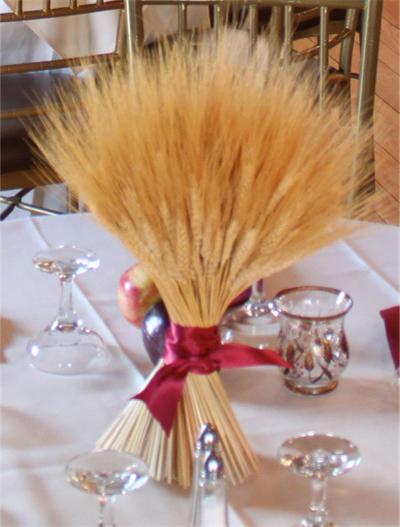 When our daughter-in-law made wheat shocks as center-pieces for hers and our son’s fall-themed wedding reception, I naturally could not help pointing out the age-old observation that they represented a hyperboloid of one sheet. This was naturally greeted with the usual groans, but the thought stayed with me as I realized I had never proved this mathematically to myself. And so I did.
 This was a catchy, misleading title that I could not resist, since my essay is not about math vs. religion as one might expect from the title, but rather about math helping religion. Back in 2016 I was reading Dr. Bart D. Ehrman’s blog that he was writing in preparation for his eventual book, The Triumph of Christianity, in which he was considering Rodney Stark’s purely mathematical analysis of the growth of Christianity in the first three centuries. Neither Rodney Stark nor Bart Ehrman described explicitly the underlying mathematical models of exponential growth that they were using and exactly what was meant by a rate of growth. Given the natural audience for the subject, these omissions were not surprising. So I thought I would clarify the math and also offer some variations on the models, which eventually reflected the actual situation more faithfully. See
 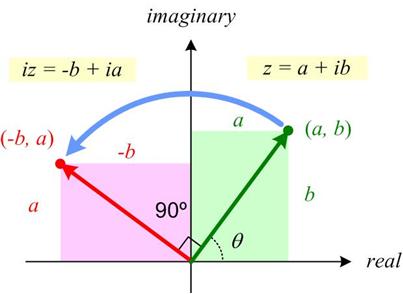 This may be a futile attempt at an elementary introduction to complex variables by emphasizing their geometric properties. The elementary part is probably undermined by an initial discussion of field extensions and a necessary reference to trigonometry. Hopefully, the suppression of the explicit use of complex powers of Euler’s constant e until the very end will allow the geometric ideas to have center stage. A primary goal of the essay is to realize that complex polynomials involve sums of circles in the plane. The image of real polynomials as wavy curves in the plane is misleading for an understanding of complex behavior. See
 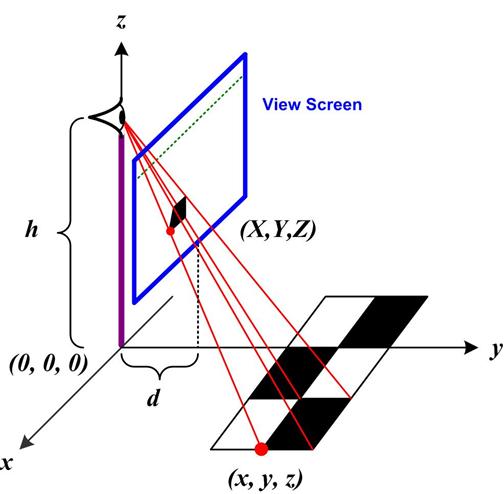 A number of recent puzzles have involved perspective views of objects. I had never really explored the idea of a perspective map in detail. So some of the properties associated with it always seemed a bit vague to me. I decided I would derive the mathematical equations for the perspective or projective map and see how its properties fell out from the equations. With this information in hand I then addressed some questions I had about the article “Dürer: Disguise, Distance, Disagreements, and Diagonals!” by Annalisa Crannell, Marc Frantz, and Fumiko Futamura concerning a controversy over Albrecht Dürer’s woodcut St. Jerome in His Study (1514). And finally, I read somewhere that a parabola under a perspective map becomes an ellipse, so I was able to show that as well. See the
  Sabine Hossenfelder wrote an excellent blog posting about the growing awareness that outstanding scientific problems are not getting solved at the same rate as in the past. Her whole article is worth a read, as are all her postings, but this latest contained a mathematical statement that warranted justification. For scientists “How much working time starting today corresponds to, say, 40 years working time starting 100 years ago. Have a guess! Answer: About 14 months.” See
 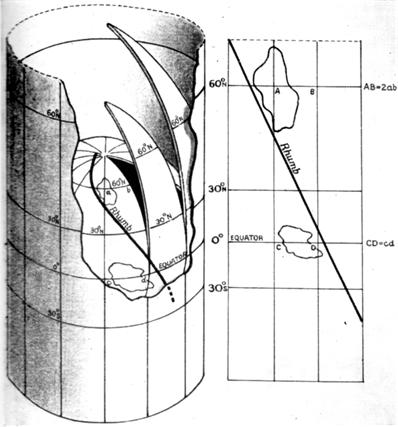 Years ago during one of my many excursions into the history of mathematics I wondered how Mercator used logarithms in his map projection (introduced in a 1569 map) when logarithms were not discovered by John Napier (1550-1617) and published in his book Mirifici Logarithmorum Canonis Descriptio until 1614, three years before his death in 1617. The mystery was solved when I read a 1958 book by D. W. Waters which said Edward Wright (1561-1615) in his 1599 book Certaine Errors in Navigation produced his “most important correction, his chart projection, now known as Mercator’s.” Wright did not use logarithms explicitly but rather implicitly through the summing of discrete secants of the latitude as scale factors. But what really caught my attention in the Waters book was this arresting footnote: “Wright explained his projection in terms of a bladder blown up inside a cylinder, a very good analogy.” This article recounts my exploration of this idea. See
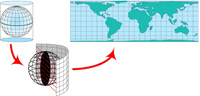 One thing I have always been curious about, but never got around to investigating, is how hard is it to see that the Lambert Equal-Area Projection of a sphere onto a cylinder in fact preserves areas? This 2012 essay attempts to provide an answer. The essay was recently updated to provide a link to the fabulous Youtube site by Grant Sanderson at
  Having immersed myself in studying Kepler’s discovery that the planetary orbits were ellipses, I was immediately aware of how the British mathematician, Katie Steckles, justified her technique to cut an elliptical pizza into equal slices in her video of 14 March 2017. In her video Katie makes the claim that the result of any affine transformation of the circular pizza cut into equal sectors will also be a set of equal area slices. I made an attempt to substantiate these remarks. See
  I have long been fascinated by Newton’s proof of Kepler’s Equal Areas Law and wanted to write about it. Of course, others have as well, but I wanted to emphasize an aspect of the proof that supported my philosophy of mathematics.