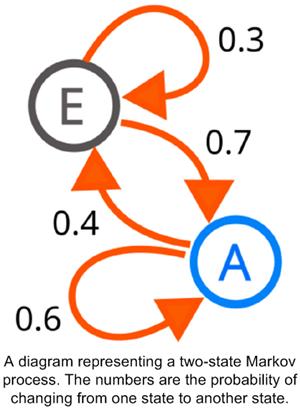
I debated posting this, but it is so rare that a human behavior would be such a perfect example of a mathematical principle that I couldn’t resist. The idea came from a great summary of the state of affairs with Trump by Anne Applebaum in The Atlantic. Continue reading
Author Archives: Jim Stevenson
A Simple Ratio
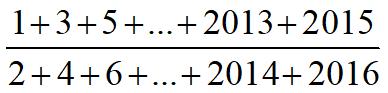
This is a straight-forward problem by Ritvik Nayak from the Puzzle Sphere.
“Evaluate the ratio. It’s actually simpler than you might think.”
Apparently it is a sample problem from the Southeast Asian Math Olympiad (SEAMO).
See A Simple Ratio for solutions.
Language Students Problem
This is a problem from the 2001 American Invitational Mathematics Exam (AIME).
“Each of the 2000 students at a high school studies either Spanish or French, and some study both. The number who study Spanish is between 80 percent and 85 percent of the school population, and the number who study French is between 30 percent and 40 percent. Let m be the smallest number of students who could study both languages, and let M be the largest number of students who could study both languages. Find M – m.”
See Language Students Problem for a solution.
Root of the Problem
This is a problem from Presh Talwalkar.
“Given that x satisfies the equation:
x4 + x3 + x2 + x + 1 = 0
What is the value of
(x33 + 2/x22)(x22 + 3/x33)”
See Root of the Problem for solutions.
Smart Money
This is a simple puzzle from Futility Closet.
“Mr. Smith goes to Atlantic City to gamble for a weekend. To guard against bad luck, he sets a policy at the start: In every game he plays, he’ll bet exactly half the money he has at the time, and he’ll make all his bets at even odds, so he’ll have an equal chance of winning and of losing this amount. In the end he wins the same number of games that he loses. Does he break even?”
See Smart Money for solutions.
Maximizing Love
This is a Valentine’s Day puzzle from BL’s (Barry Leung) Math Games.
“Happy Valentine’s Day everyone, I hope you are having a euphoric moment, but if not, you can try this algebra puzzle about maximizing the expression LUV + LU + UV + LV given L + U + V = 12, where L, U, V are non-negative integers.”
See Maximizing Love for a solution.
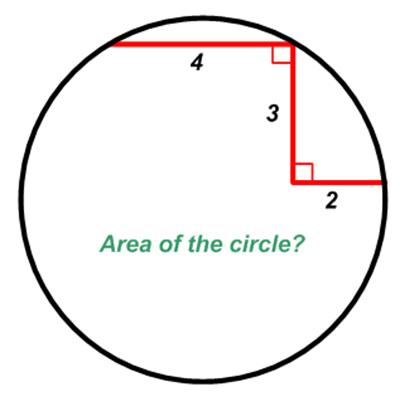
Circle-Step Puzzle
This is a straight-forward problem from Osdinato on Twitter in 2018.
“Find the area of the circle in the figure.”
See Circle-Step Puzzle for a solution.
Trains Meeting
This is a puzzle from Boris Kordemsky’s 1972 Moscow Puzzles.
“Two freight trains, each 1/6 mile long and traveling 60 miles per hour, meet and pass each other. How many seconds is it between when the locomotives pass each other and the cabooses pass each other?”
See Trains Meeting for solutions.
Three Buckets Question
From Presh Talwalkar here is a variation of the three jugs problem.
“You have buckets that hold 3 L, 7 L, and 20 L of water. How can you measure the following amounts?
- a) 10 L
- b) 4 L
- c) 5 L
For most of mathematical history the above information would be sufficient information to state the problem. But in today’s society, there is a demand to state all assumptions as if that will make the problem better. So the test explained there are certain actions you can take.
You can fill any bucket completely with water. You can pour all the water from a bucket into a larger bucket. You can pour water from a bucket to fill a smaller bucket. You can empty the water completely from any bucket.”
See the Three Buckets Question for solutions.

Interest Calculations
A recent video by Angela Collier about compound interest reminded me of an effort I did years ago to derive the formulas for interest calculations, especially for installment payments on a loan like a mortgage. In the process I showed where Euler’s constant e can show up. I thought I would resurrect the material, even though I imagine modern texts now provide the information (I couldn’t easily locate it back then).