
 Being born on February 29 I have always had an interest in the calendar and the mechanics of Leap Year. Since I am sure everyone knows about Leap Year, I will just rattle off a few trivia questions to stimulate the memory. Why was I excited about my birthday in 2000 when everyone knew it was a Leap Year, being 4 years after 1996? When I lived in Brazil, everyone referred to Leap Year as bissextile. What was that all about? After the Gregorian reform in 1582, how come George Washington’s mother recorded his birth in their family bible as 11 February 1731 when we say it is 22 February 1732 (whereas Abraham Lincoln’s mother recorded 12 February 1809 for her son, which we agree with)? See February 29.
Update (2/29/2020) Continue reading
 I have almost completed my original goal of publishing articles I have written to myself over the last several years regarding matters mathematical (together with a sprinkling of more recent items). From the visit counts I can tell someone is reading them, but other than spam from porn and gambling sites and intrusions from Russian bots, I have received no feedback on the material in comments, nor via the more private venue of email: mathmeditations@josmfs.net.
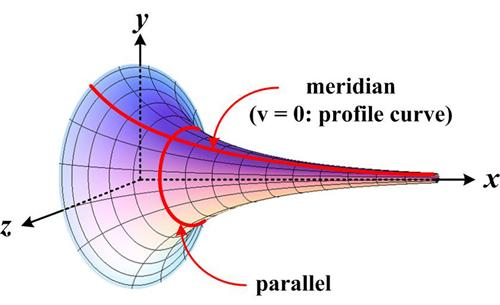 This essay began as an effort to prove Tanya Khovanova’s statement in her article “The Annoyance of Hyperbolic Surfaces” that her crocheted hyperbolic surface had constant (negative) curvature. I discussed Khovanova’s article in my previous essay “
 Tanya Khovanova’s recent blog post “The Annoyance of Hyperbolic Surfaces” about crocheting a hyperbolic surface added to the numerous examples of such activity, usually from knitting. Somehow this post caught my attention, in particular about the exponential growth of each added row and the fact that the resulting “surface” had constant negative curvature. I explored the exponential growth in this article and saved the mathematical exploration of the constant negative curvature for a later essay. See
 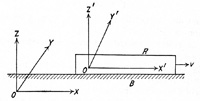 Over the years one of the subjects I return to periodically to study is Einstein’s Theory of Relativity, both the Special and General theories. Interest in the Special Theory focused on the derivation of the Lorentz transformations (or contractions). Why did objects appear with different lengths and clocks run at different speeds for observers moving relative to one another? Early on (late 60s) I came across a great explanation in the 1923 book by C. P. Steinmetz. He derived it from two general assumptions of special relativity: (1) that all motion is relative, the motion of the railway train relative to the track being the same as the motion of the track relative to the train, and (2) that the laws of nature, and thus the velocity of light, are the same everywhere. I did not follow his derivation completely, so I produced my own, which I will give here. See the
  This problem posted by Presh Talwalkar offers a variety of solutions, but I didn’t quite see my favorite approach for such problems. So I thought I would add it to the mix.
 This was a nice geometric problem from Poo-Sung Park
 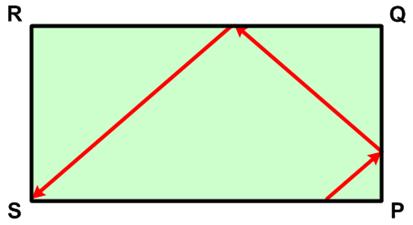 This is another UKMT Senior Challenge problem, this time from 2006.
 I came across the following problem from an Italian high school exam on the British

 Normally I don’t care for combinatorial problems, but this problem from


