
 From Presh Talwalkar here is a variation of the three jugs problem.
“You have buckets that hold 3 L, 7 L, and 20 L of water. How can you measure the following amounts?
- a) 10 L
- b) 4 L
- c) 5 L
For most of mathematical history the above information would be sufficient information to state the problem. But in today’s society, there is a demand to state all assumptions as if that will make the problem better. So the test explained there are certain actions you can take.
You can fill any bucket completely with water. You can pour all the water from a bucket into a larger bucket. You can pour water from a bucket to fill a smaller bucket. You can empty the water completely from any bucket.”
See the Three Buckets Question for solutions.
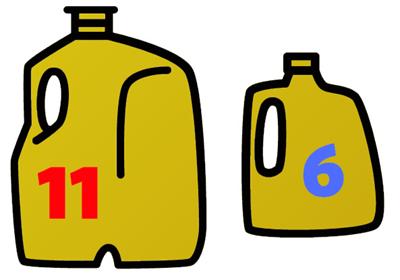 Here is another classic example of the three jug problem posed in the Mathigon Puzzle Calendars for 2017.
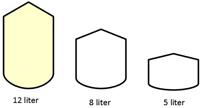 I was sifting back through some problems posed by Presh Talwalkar on his website
 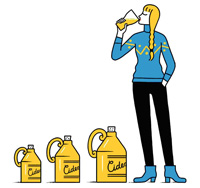 This is another problem from the defunct Wall Street Journal Varsity Math Week column.
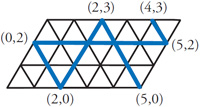 Years ago (1967) I read about an interesting solution to the three jugs problem in a book by Nathan Court which involved the idea of a billiard ball traversing a skew billiard table with distributions of the water between the jugs listed along the edges of the table. The ball bounced between solutions until it ended on the desired value. I thought it was very clever, but I really did not understand why it worked. Later I figured out an explanation, which I present here. See the