 Here is a seemingly simple problem from Futility Closet.
“A quickie from Peter Winkler’s Mathematical Puzzles, 2021: Can West Virginia be inscribed in a square? That is, is it possible to draw some square each of whose four sides is tangent to this shape?”
Technically we might rephrase this as, can we inscribe a flat map of West Virginia in a square, since the boundary of most states is probably not differentiable everywhere, that is, has a tangent everywhere.
But the real significance of the problem is that it is an example of an “existence proof”, which in mathematics refers to a proof that asserts the existence of a solution to a problem, but does not (or cannot) produce the solution itself. These proofs are second in delight only to the “impossible proofs” which prove that something is impossible, such as trisecting an angle solely with ruler and compass.
Here is another classic example (whose origin I don’t recall). Consider the temperatures of the earth around the equator. At any given instant of time there must be at least two antipodal points that have the same temperature. (Antipodal points are the opposite ends of a diameter through the center of the earth.)
See Existence Proofs (revised)
(Update 10/2/2021) I fixed a minor typo: “tail” should have been “head”

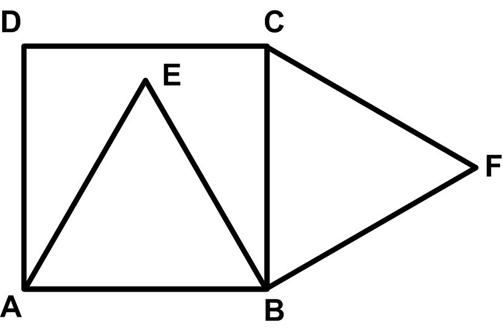 This is a fairly simple problem from Futility Closet, which is currently under a hiatus.
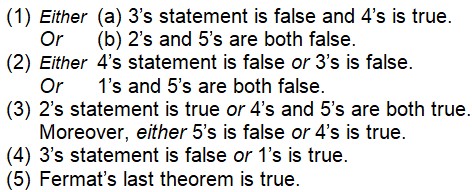
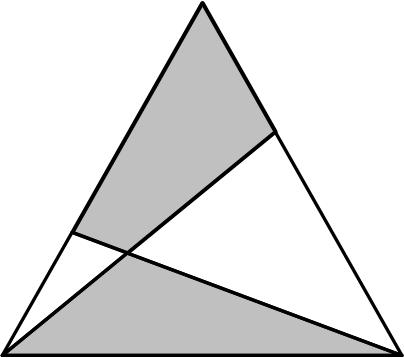 This is another fairly simple puzzle from Futility Closet from a while ago (2014).
 Futility Closet has another
 Futility Closet
 Here is a simple problem from an old
 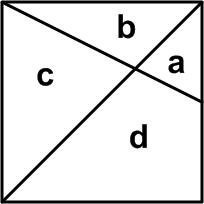 Here is a simple Futility Closet problem from 2014.
 Here is a nice logic puzzle from 2014 Futility Closet.


