Tag Archives: Futility Closet

Smart Money

This is a simple puzzle from Futility Closet.

“Mr. Smith goes to Atlantic City to gamble for a weekend. To guard against bad luck, he sets a policy at the start: In every game he plays, he’ll bet exactly half the money he has at the time, and he’ll make all his bets at even odds, so he’ll have an equal chance of winning and of losing this amount. In the end he wins the same number of games that he loses. Does he break even?”

Answer.

See Smart Money for solutions.

Mixed Emotions

This is a brainteaser by S. Ageyev from the November-December 1991 issue of Quantum given in Futility Closet.

“The numbers 1, 2, …, 100 are arranged in a 10 x 10 square table in their natural order (1 in the top left comer, 100 in the bottom right comer). The signs of 50 of these numbers are changed in such a way that exactly half of the numbers in each line and each column get the minus sign. Prove that the sum of all the numbers in the table after this change is zero.”

See Mixed Emotions for solutions.

Wittenbauer’s Parallelogram

This is a lovely result from Futility Closet.

“Draw an arbitrary quadrilateral and divide each of its sides into three equal parts. Draw a line through adjacent points of trisection on either side of each vertex and you’ll have a parallelogram.

Discovered by Austrian engineer Ferdinand Wittenbauer.”

Find a proof.

See Wittenbauer’s Parallelogram for a solution.

A Number Maze

Here is an entertaining puzzle from Futility Closet.

“By Wikimedia user Efbrazil. Begin at the star. The number at your current position tells you the number of blocks that your next jump must span. All jumps must be orthogonal. So, for example, your first jump must take you to the 1 in the lower left corner or the 2 in the upper right. What sequence of jumps will return you to the star?”

See A Number Maze for solutions

NSA Track and Field Puzzle

This is a puzzle from Futility Closet.

“A puzzle by Steven T., a systems engineer at the National Security Agency, from the NSA’s September 2016 Puzzle Periodical:

Three athletes (and only three athletes) participate in a series of track and field events. Points are awarded for 1st, 2nd, and 3rd place in each event (the same points for each event, i.e. 1st always gets “x” points, 2nd always gets “y” points, 3rd always gets “z” points), with x > y > z > 0, and all point values being integers.

The athletes are named Adam, Bob, and Charlie.

  • Adam finished first overall with 22 points.
  • Bob won the Javelin event and finished with 9 points overall.
  • Charlie also finished with 9 points overall.

Question: Who finished second in the 100-meter dash (and why)?”

I thought this puzzle impossible at first.  There didn’t seem to be enough information to solve it.  But a bit of trial-and-error opened a path.

Answer.

See NSA Track and Field Puzzle for solutions.

Hjelmslev’s Theorem

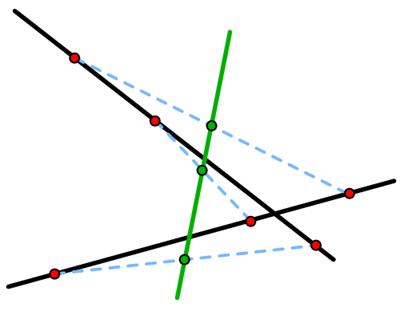
I came across this remarkable result in Futility Closet:

“On each of these two black lines is a trio of red points marked by the same distances.  The midpoints of segments drawn between corresponding points are collinear.

(Discovered by Danish mathematician Johannes Hjelmslev.)”

This result seems amazing and mysterious.  I wondered if I could think of a proof.  I found a simple approach that did not use plane geometry.  And suddenly, like a magic trick exposed, the result seemed obvious.

See Hjelmslev’s Theorem

Classic Geometry Paradox

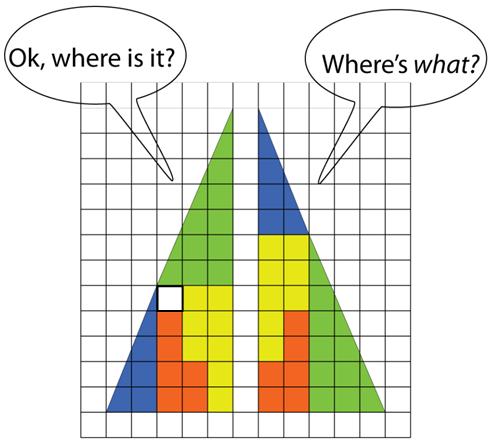
Coming across this classic geometric paradox recently in Futility Closet motivated me to write down its solution in detail.

“Where did the empty square come from?”

In any case, this is the canonical example for why I avoid visual geometric proofs—you can be so easily fooled.  Real proofs require plane or analytic geometry arguments.

See the Classic Geometry Paradox

(Update 9/14/2024) Penn & Teller – Fool Us – Magic Trick
Continue reading

Box Code Puzzle

This is an intriguing puzzle from Futility Closet.

“In Robert Chambers’ 1906 novel The Tracer of Lost Persons, Mr. Keen copies the figure below from a mysterious photograph. He is trying to help Captain Harren find a young woman with whom he has become obsessed.

‘It’s the strangest cipher I ever encountered,’ he says at length. ‘The strangest I ever heard of. I have seen hundreds of ciphers—hundreds—secret codes of the State Department, secret military codes, elaborate Oriental ciphers, symbols used in commercial transactions, symbols used by criminals and every species of malefactor. And every one of them can be solved with time and patience and a little knowledge of the subject. But this … this is too simple.’

The message reveals the name of the young woman whom Captain Harren has been seeking. What is it?”
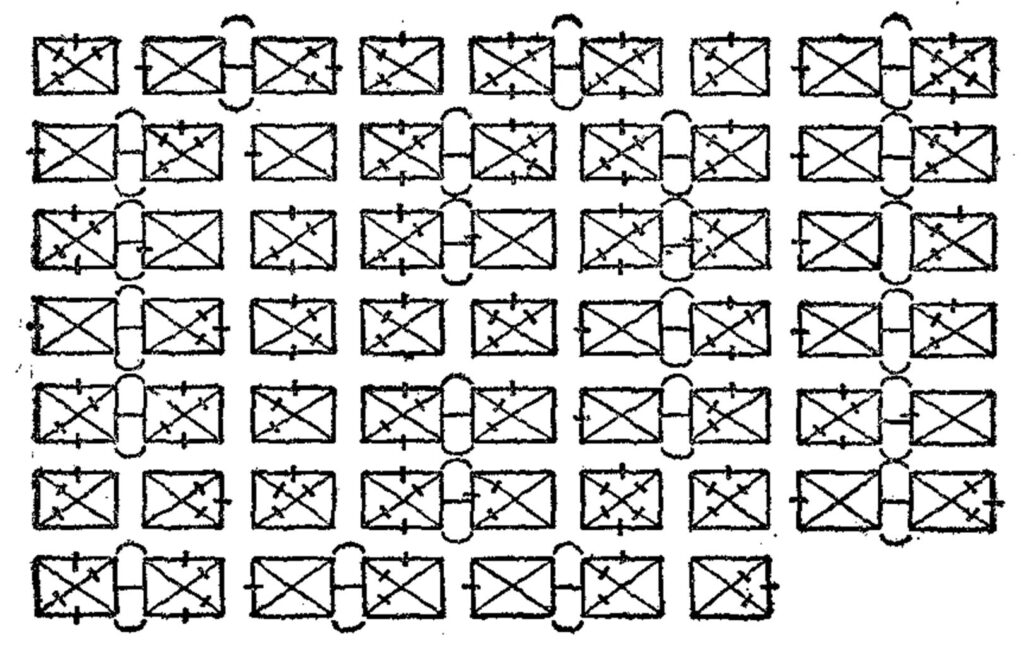
As is usual with these types of puzzles, I felt foolish that I couldn’t see the immediate, simple interpretation of the boxes—after a great deal of effort.  So I solved it using the usual cryptographic methods that rely heavily on logic and letter frequencies, though the message is a bit short for that.

Answer.

See Box Code Puzzle for solutions.