
 Another good source of problems is the Futility Closet site. This puzzle involved finding the line of maximal length passing through the intersection of two circles. I solved it before looking at the Futility Closet solution. Their solution of course was short, sweet, and elegant. Mine was more like the old adage of cracking a walnut with a sledge hammer. Still, I thought there were some unexplained parts to the elegant solution that justified the effort on mine. At least my solution provided an interesting, though convoluted, alternative. See the Two Circles Puzzle.
Ant Problem
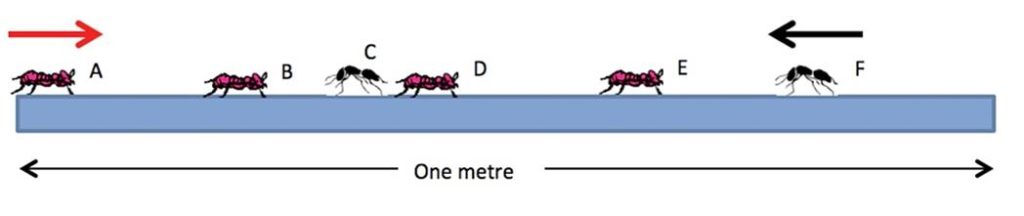
This is one of Alex Bellos’s Monday Puzzles in the Guardian. I basically found the same solution as Bellos and his commenters, but wrote it up with what I thought were more explanatory graphics. The idea is that there is a bunch of ants on a stick who all walk a the same speed of 1 centimeter per second. When an ant runs into another ant, they both turn around and go the opposite direction. “So here is the puzzle: Which ant is the last to fall off the stick? And how long will it be before he or she does fall off?” See the Ant Problem.

(Update 3/1/2025) Alternative Problem
Consider what happens when the stick is bent into a ring. See the Circular Ant Problem.
Earth as Magnet
 This was one of my more satisfying essays. Several years ago I gave some thought to what it meant for the earth to be considered a magnet. More recently in 2012 an article in the magazine BirdWatching brought it all back when I saw its diagram of the earth as a magnet for guiding migratory birds. Knowing that magnets have north and south poles, where should we expect to find the earth’s north and south magnetic poles? See Earth as Magnet.
Update (2/28/2025) Even Experts Slip Up
Continue reading
Vitruvian Man Problem
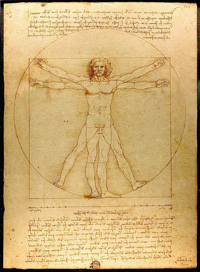 This is a mildly pointless 2015 article about Leonardo Da Vinci’s famous drawing of the Vitruvian Man spread-eagled and inscribed in a circle and a square. I started wondering about the positions and whether they over-determined the circle and square. What hidden constraints were being assumed? One assumption turned out to be famous, namely, that the height of a man equaled the distance between his finger tips when he holds his arms straight out to either side of his body. I had been told this in childhood, and I never knew where it came from. Also, I don’t think it is true in every case (what about women?), though it does appear to be close (and is true in my case). See the Vitruvian Man Problem.
Degree of Latitude
South Dakota Travel Problem
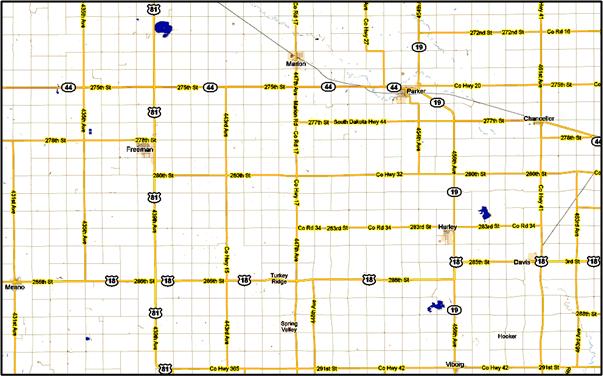 This light-weight problem arose from a newspaper article that had me looking at a Google map of the area near Sioux Falls, South Dakota. What I saw was an excellent example of the Taxicab Geometry, allegedly first considered by Hermann Minkowski, mathematical friend of Albert Einstein. The map configuration was perpetrated by the great Public Land Survey System (PLSS) that originated with Thomas Jefferson and spread from Ohio (more or less) west to the California coast. This scheme overlaid the country basically with a 1 mile x 1 mile square grid of roads, and South Dakota is a prime example.
I first confronted the PLSS doing genealogy research, where the grid became a main method for locating the farms of ancestors. I had no idea it was so extensive. A fabulous book about the system and the history of land surveying in America is Andro Linklater’s Measuring America: How the United States Was Shaped By the Greatest Land Sale in History (2002). I learned all about perches and 17th century English mathematician Edmund Gunter’s survey chain, which became an essential tool for so vast a survey undertaking. Regarding the implications of the PLSS in South Dakota, see the South Dakota Travel Problem.
Point Set Topology
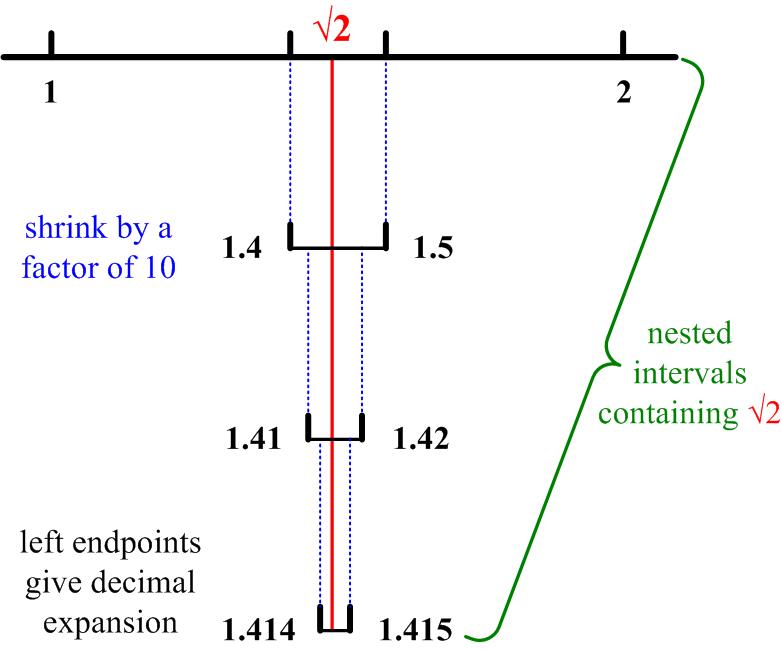 Probably the most satisfying article I have put together is a recent one on point set topology. An old friend of mine, who studied math and physics in college but ended up getting a doctorate in English, asked me, what was topology? Knowing that there were two main branches of topology (general or point set topology and algebraic topology), I chose to describe point set topology first, especially since it was what I was most familiar with and had worked with most in my graduate work.
The essay turned out to have a surprising structure more like a musical theme and variations. The theme was the geometric series. I found it to be a wonderful medium to show the evolution of ideas (acting as variations) from the early Greeks (Zeno’s Paradoxes) through the development of calculus, decimal expansions of real numbers, to power series, metric spaces, and finally general topologies.
There was an additional benefit to this series of transformations of an initial idea: one of the major aspects of true mathematics became evident, namely, the extension of an idea into new territories that reveal unexpected connections to other forms of mathematics. Treating complicated functions as points in a topological space was a wonderful idea developed over the end of the 19th and beginning of the 20th centuries and became the basis of the field of functional analysis. See Point Set Topology (revised).
(Update 6/3/2021) Slightly revised version.
I happened to review this article and noticed I made a mistake in my integration example. I have no idea what I was thinking at the time, so I corrected it. As I reviewed the rest of the article, I noticed a bunch of “typos” that would make the text confusing, so I corrected those as well. And finally I rephrased wording in a couple of places to try to make things clearer.
Power of 2 Problem
 Virtually the very first “math” problem I got interested in involved a 7th grade homework problem in 2005 that a colleague at work said her son had been given. I ended up commenting and helping on a number of further problems, which gave me some insight into the state of current public school teaching in mathematics. It was both encouraging and discouraging at the same time. I will join the math education commentary at a later date.
The problem was not that bad: What is the largest power of 2 that divides 800! without a remainder? (where “!” means “factorial”, for example, 5! = 5 x 4 x 3 x 2 x 1). I solved it in my usual pedestrian way. I showed it to a friend of mine (an algebraist!) and he of course had a nifty approach. He showed it to a colleague of his at NSF (a physicist) and he had the niftiest solution of all! (Most humbling.) See the Power of 2 Problem.

Ancestors Problem
 In 2011 I wrote about an amusing article in the 9 September 1978 Washington Post in which the reporter, Henry Allen, began thinking about the number of ancestors he had 10 generations ago. He figured that each generation had 2 parents, so the 10th generation would have 2^10 or over a thousand members. At 25 years per generation he started imagining the expanding number of direct ancestors he had going back through history, achieving astronomical numbers, which did not seem reasonable. As reporters do, he started interviewing people to get to the bottom of the problem. See the Ancestors Problem.
One thing that did come out of the exercise is that I began researching the idea of Most Recent Common Ancestor (MRCA). It led to a number of approaches from statistical to molecular evolution markers. I was hoping to write more about it when I had the time. An example of the statistical approach is the article by Joseph Lachance, “Inbreeding, Pedigree Size, and the Most Recent Common Ancestor of Humanity,” J Theor Biol. 2009 November 21; 261(2): 238–247. Online 2009 August 11. doi: 10.1016/j.jtbi.2009.08.006
(Update 5/10/2019) Continue reading
Microwave Problem
 As my opening post, I begin with something I noticed back in 2011 when we purchased a new microwave that had a revolving carousel to distribute the heating. The glass plate was turning faster than the plastic support ring under it. I wondered if the speed depended on the size of the support ring and/or the size of its roller wheels. Here is what I discovered.