
 This is a collection of simple but elegant puzzles, mostly from a British high school math teacher Catriona Shearer, for which I thought I would show solutions (solutions for a number of them had not been posted yet on Twitter at the time of writing). See the Geometric Puzzle Medley.
Apparently Catriona Shearer creates these problems herself, which shows an especially gifted talent. Ben Olin, of Math with Bad Drawings fame, had an interesting interview with Ms. Shearer. The reason for the interest in her work becomes evident the more of her geometry problems one sees. They are especially elegant and minimalist, and often have simple solutions, as exemplified by the “5 Problem” or “Shear Beauty” problem illustrated here. Words, such as “beauty” and “elegance”, are often bandied about concerning various mathematical subjects, but as with any discussion of esthetics, the efforts at explanation usually fall flat. Shearer’s problems are one of the best examples of these ideas I have ever seen. If you contemplate her problems and even solve them, you will understand the meaning of these descriptions.
One of the key aspects of mathematics is often its “hidden-ness” (some would say “opacity” or “incomprehension”). Her problems appear to have insufficient information to solve. But as you look at the usually regular figures, you see that there are inherent rigid constraints that soon yield specific information that leads to a solution. This discovery is akin to the sensation of discovering Newton’s mathematical laws underlying physical reality. It is the essence of one of the joys of mathematics.
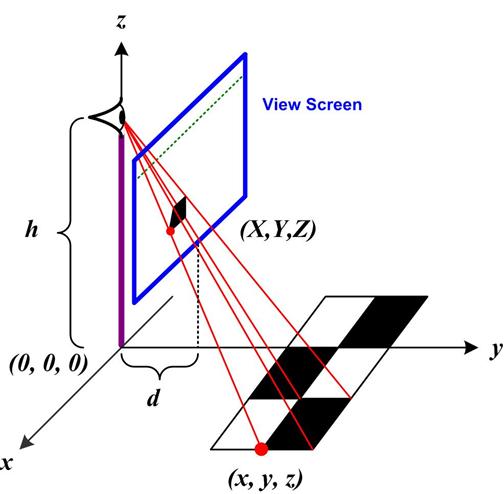 A number of recent puzzles have involved perspective views of objects. I had never really explored the idea of a perspective map in detail. So some of the properties associated with it always seemed a bit vague to me. I decided I would derive the mathematical equations for the perspective or projective map and see how its properties fell out from the equations. With this information in hand I then addressed some questions I had about the article “Dürer: Disguise, Distance, Disagreements, and Diagonals!” by Annalisa Crannell, Marc Frantz, and Fumiko Futamura concerning a controversy over Albrecht Dürer’s woodcut St. Jerome in His Study (1514). And finally, I read somewhere that a parabola under a perspective map becomes an ellipse, so I was able to show that as well. See the
  Sabine Hossenfelder wrote an excellent blog posting about the growing awareness that outstanding scientific problems are not getting solved at the same rate as in the past. Her whole article is worth a read, as are all her postings, but this latest contained a mathematical statement that warranted justification. For scientists “How much working time starting today corresponds to, say, 40 years working time starting 100 years ago. Have a guess! Answer: About 14 months.” See
  This problem comes from the defunct Wall Street Journal Varsity Math Week collection.
 Yet another
  This is another
 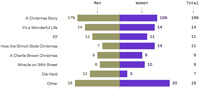 Reading Axios on Christmas Eve day 2017, I was struck by what appeared at first to be a strange graph showing preferences for Christmas movies divided between men and women. The thing that struck me as strange was the computation for the total votes: the percentages were the average of the men and women percentages. This, of course, is not how you average percentages. What was going on? See
  Recently I viewed a startling
  I came across the following entry in the
 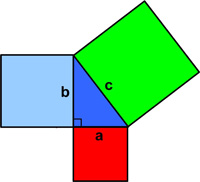 All too frequently I come across the usual statements questioning why non-technical folks should bother studying math. A typical example is the Pythagorean Theorem. People say, “What good is that? I’ll never use it. So why bother?” Ah, the famous “utility” argument – as if everything worthwhile must be “useful.” I thought I would take this “useless” math example par excellence and show that, in fact, it harbors many of the best aspects of mathematics that anyone should find appealing. See the

