
 The following interesting behavior was found at the Futility Closet website:
“A pleasing fact from David Wells’ Archimedes Mathematics Education Newsletter: Draw two parallel lines. Fix a point A on one line and move a second point B along the other line. If an equilateral triangle is constructed with these two points as two of its vertices, then as the second point moves, the third vertex C of the triangle will trace out a straight line. Thanks to reader Matthew Scroggs for the tip and the GIF.”
This is rather amazing and cries out for a proof. It also raises the question of how anyone noticed this behavior in the first place. I proved the result with calculus, but I wonder if there is a slicker way that makes it more obvious. See the Straight and Narrow Problem.
(Update 3/25/2019) Continue reading
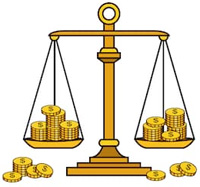 Futility Closet presented a nifty method of solving the “counterfeit coin in 12 coins” problem in a way I had not seen before by mapping the problem into numbers in base 3. It wasn’t immediately clear to me how their solution worked, so I decided to write up my own explanation.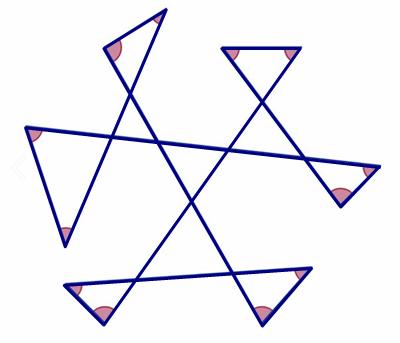
 Setting aside my chagrin that the following problem was given to pre-university students, I initially found the problem to be among the daunting ones that offer little information for a solution. It also was a bit “inelegant” to my way of thinking, since it involved considering some separate cases. Still, the end result turned out to be unique and satisfying (Talwalkar’s Note 2 was essential for a unique solution, since the problem as stated was ambiguous).
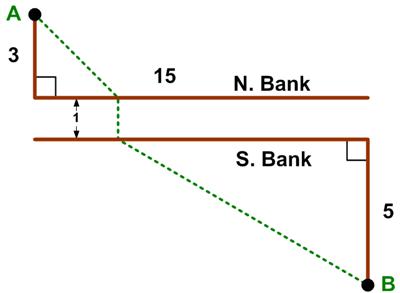 This is a riff on a classic problem, given in Challenging Problems in Algebra.
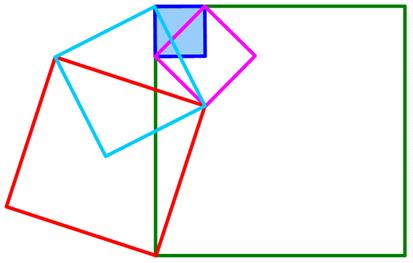 Here is another imaginative geometry problem from
 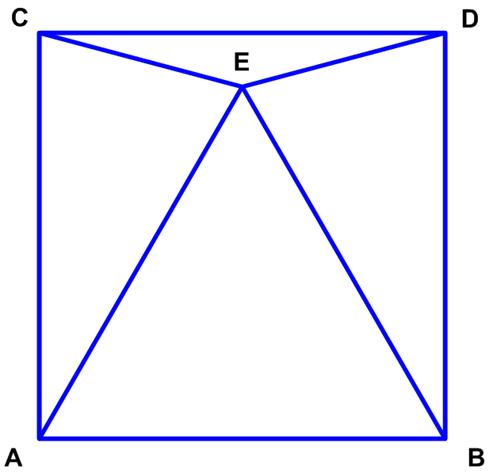 The issue 7 of the Chalkdust mathematics magazine had an interesting geometric problem presented by Matthew Scroggs.
 It is a bit presumptuous to think I could reduce the universe of mathematics to some succinct essence, but ever since I first saw a column in Martin Gardner’s Scientific American Mathematical Games in 1967, I thought his example illustrated the essential feature of mathematics, or at least one of its principal attributes. And he posed it in a way that would be accessible to anyone. I especially wanted to credit Martin Gardner, since the idea resurfaced recently, uncredited, in some attractive videos by Katie Steckles and James Grime. (This reminds me of the Borges idea that “eighty years of oblivion are perhaps equal to novelty”.) See the
  Being born on February 29 I have always had an interest in the calendar and the mechanics of Leap Year. Since I am sure everyone knows about Leap Year, I will just rattle off a few trivia questions to stimulate the memory. Why was I excited about my birthday in 2000 when everyone knew it was a Leap Year, being 4 years after 1996? When I lived in Brazil, everyone referred to Leap Year as bissextile. What was that all about? After the Gregorian reform in 1582, how come George Washington’s mother recorded his birth in their family bible as 11 February 1731 when we say it is 22 February 1732 (whereas Abraham Lincoln’s mother recorded 12 February 1809 for her son, which we agree with)? See
  I have almost completed my original goal of publishing articles I have written to myself over the last several years regarding matters mathematical (together with a sprinkling of more recent items). From the visit counts I can tell someone is reading them, but other than spam from porn and gambling sites and intrusions from Russian bots, I have received no feedback on the material in comments, nor via the more private venue of email: mathmeditations@josmfs.net.


