 This is a problem from Presh Talwalkar.
“Given that x satisfies the equation:
x4 + x3 + x2 + x + 1 = 0
What is the value of
(x33 + 2/x22)(x22 + 3/x33)”

See Root of the Problem for solutions.

This is a problem from Presh Talwalkar.
“Given that x satisfies the equation:
x4 + x3 + x2 + x + 1 = 0
What is the value of
(x33 + 2/x22)(x22 + 3/x33)”
See Root of the Problem for solutions.
 From Presh Talwalkar here is a variation of the three jugs problem.
“You have buckets that hold 3 L, 7 L, and 20 L of water. How can you measure the following amounts?
For most of mathematical history the above information would be sufficient information to state the problem. But in today’s society, there is a demand to state all assumptions as if that will make the problem better. So the test explained there are certain actions you can take.
You can fill any bucket completely with water. You can pour all the water from a bucket into a larger bucket. You can pour water from a bucket to fill a smaller bucket. You can empty the water completely from any bucket.”
See the Three Buckets Question for solutions.
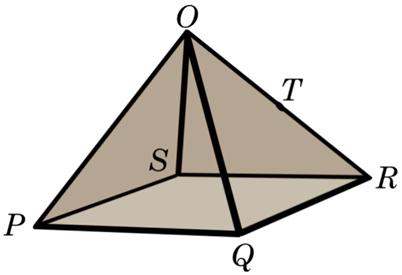 This is an earlier puzzle from Presh Talwalkar.
“A square pyramid has base PQRS and vertex O. Each edge has length equal to 20. Calculate the shortest distance along the outer surface of the pyramid from P to T, the midpoint of OR.”
See Shortest Pyramid Path for solutions.
 This is a puzzle from Talwalkar’s set of “Impossible Puzzles with Surprising Solutions.”
“Call this puzzle the leaning tower of rhombi.
There are 5 isosceles triangles, aligned along their bases, with base lengths of 12, 13, 14, 15, 16 cm. The 10 quadrilaterals above are in rows of 4, 3, 2, and 1. Each quadrilateral is a rhombus, and the top of the tower is a square. What is the area of the square?”
See Stacked Rhombuses Puzzle for solutions.
 This is a classic puzzle from Presh Talwalkar.
“This puzzle has been asked as an interview question at tech companies like Google.
There are 100 lights numbered 1 to 100, all starting in the off position. There are also 100 people numbered 1 to 100. First, person 1 toggles every light switch (toggle means to change from off to on, or change from on to off). Then person 2 toggles every 2nd light switch, and so on, where person i toggles every ith light switch. The last person is person 100 who toggles every 100th switch.
After all 100 people have passed, which light bulbs will be turned on?”
I vaguely remembered the answer, which I confirmed after a few examples. But I didn’t remember an exact proof, so I thought I would give it a try.
See 100 Light Bulbs Puzzle for solutions.
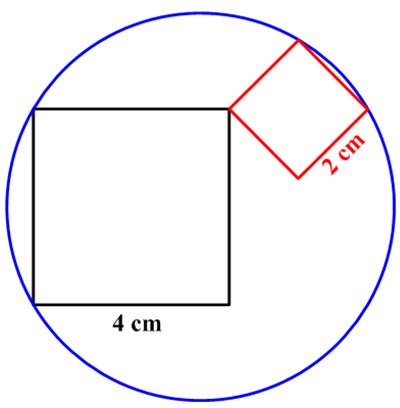 This puzzle, from another set of seven challenges assembled by Presh Talwalkar, turned out to be very challenging for me.
“This is a fun problem I saw on Reddit AskMath. A circle contains two squares with sides of 4 and 2 cm that overlap at one point, as shown. What is the area of the circle?”
This took me quite a while to figure out, but I relied on another problem I had posted earlier.
See Two Squares in a Circle for solutions.
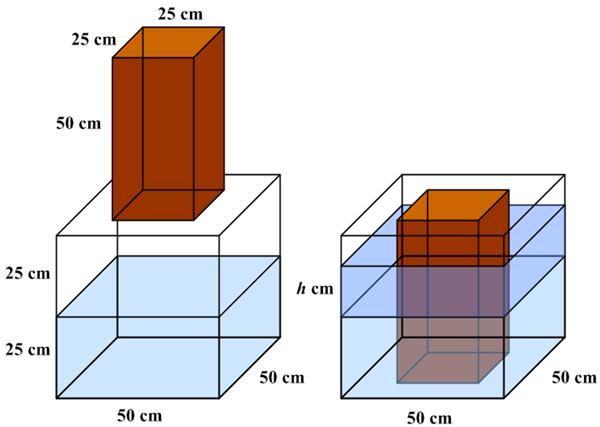 I thought this puzzle, which was included among a set of seven challenges assembled by Presh Talwalkar, would be fairly straight-forward.
“A cube of 50 cm is filled halfway with water. A rectangular prism with a square base of 25 cm and a height around 50 cm is placed flat onto the base of the cube, as shown. By how much does the water level rise?
Thanks to Fahad Alomaim for the suggestion! This is translated from a Mawhiba curriculum question for 8th grade.”
But I got the wrong answer and found Talwalkar’s solution a bit hard to fathom at first. Looks like I flunked 8th grade.
See Brick in Water Puzzle for solutions.
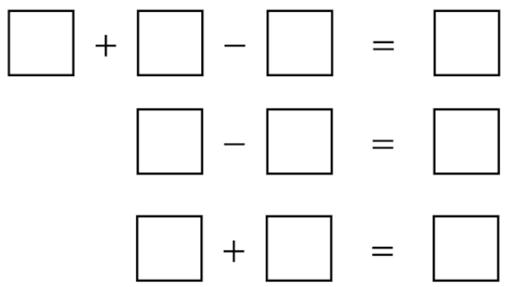 This is a somewhat unusual problem from Presh Talwalkar. It involves proving a student’s homework problem is impossible.
“I came across a homework problem described as “scary” on Reddit AskMath. You need to fill in the number sentences using the numbers 0, 1, 2, 3, 4, 5, 6, 7, 8, 9 exactly once.
You should try a few possibilities to see why this is a challenging question. And do not waste too much time because the exercise is literally impossible! The challenge is, can you prove no solution exists?”
See Impossible Homework for a solution.
 This is another intimidating puzzle from Presh Talwalkar:
“Thanks to Eric from Miami for suggesting this problem and sending a solution!
From a 5th grade Chinese textbook: In the quadrilateral ABCD, angle A = 90°, angle ABD = 40°, angle BDC = 5°, angle C = 45°, and the length of AB is 6. Find the area of the quadrilateral ABCD.”
See the Chinese Quadrilateral Puzzle for solutions.
 Presh Talwalkar has an interesting new problem.
“Students and teachers found a recent test in New Zealand to be confusing and challenging for covering topics that were not taught in class.
For the equation below, find the value of k for which the equation has numerically equal but opposite signs (for example, 2 and –2):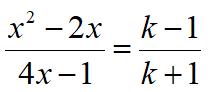 ”
”
The problem didn’t mention how old the students were, but the solution to another problem on the test indicates they needed to know calculus.
See Mystery Quadratic for a solution.


