 This essay is slightly tangential to my usual fare, but it is prompted by a most amazing video that convinced me that the impact of AI this time is not hype, but rather a real threat to our society. I found the video at 3 Quarks Daily and it was of Johnny Cash singing a song called “Barbie Girl” to the tune of his trademark Folsom Prison Blues—only it wasn’t the late Johnny Cash (1932–2003), it was AI!
See Voice Stealing
(Update 11/2/2023) I was wondering why the seeming lack of interest in this post, and then I tried the link to the video and found it has been removed from the public. There must be a reason, probably copyright issues somewhere, so even though I got a copy when it was public, I don’t think I should post it. This is really too bad, since it is in incredible example of what may be our dystopian future. I just rooted around and found another link that seems to be working. I have updated the text above.
(Update 5/4/2024) It gets worse. The Atlantic article “My Journey Inside the Voice-Clone Factory” shows what happens when voice-cloning is combined with image-cloning and OpenAI language models. It is a dystopian nightmare beyond imagining.
(Update 12/28/2025) And worse. Two recent, short articles show plausible scenarios for the rapidly approaching future. The first, “Digital Doppelganger — You and ‘You’ ”, dramatizes how the delegation of your public persona to AI apps ends up replacing you.
And the second, “How AI Is Taking Us Back To The Dark Ages”, shows how our increasing reliance on AI is delegating our independent thinking, so hard-won in the Enlightenment, back to a central authority.

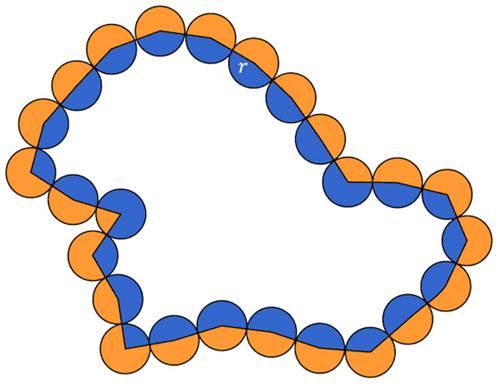 This is a nifty problem from Presh Talwalkar.
 This is a fairly extensive clock problem by Geoffrey Mott-Smith from 1954.
 This is a slightly challenging problem from Dan Griller.
 Since the changes in Twitter (now X), I have not been able to see the posts, not being a subscriber. But I noticed poking around that some twitter accounts were still viewable. However, like some demented aging octogenarian they had lost track of time, that is, instead of being sorted with the most recent post first, they showed a random scattering of posts from different times. So a current post could be right next to one several years ago. That is what I discovered with the now defunct MathsMonday site. I found a
 This is another puzzle from the Maths Masters team, Burkard Polster (aka Mathologer) and Marty Ross as part of their “Summer Quizzes” offerings.
 Another
  A prevalent theme of much of popular mathematical exposition and debates about mathematics education concerns how to interest a wider population in matters mathematical. For the most part I feel that essays that try to present the “beauty” of mathematics are doomed to failure, as are most discussions of esthetics. The underlying goal of such writing is a legitimate and laudable attempt to show the appeal of math. But I fear it succeeds only with those already converted. So is there another way?
 After a hiatus of four years, Stephen Welch is back with some timely videos at


