Tag Archives: logic

Hangover Clock Reading

This is another clock puzzle from the 1978 Eureka magazine.

“The hands on my alarm clock are indistinguishable, and there are no numbers around the outside. Accidentally woken up by it one morning, I observed with a snarl that the hands were both pointing at minute divisions, and that they were 9 minutes apart.

Had it not been for my hangover, what could I have deduced?”

Answer.

See the Hangover Clock Reading for a solution.

The King of the Spiders

Continuing the logic thread, this is a nice logic problem from MathsJam Shout for April 2025.

“The king of the spiders has four servants, and the servants have either 6, 7, or 8 legs.  Servants with 7 legs always lie, and servants with 6 or 8 legs always tell the truth.

The king asks ‘How many legs do you four have in total?’, and the four spider servants (who are standing behind a table, so you can’t see their legs) answer 25, 26, 27, and 28, respectively.

Who is telling the truth?”

Answer.

See The King of the Spiders for a solution.

Logical Card Test

This is a logical puzzle from Muhammad Zain Sarwar on Puzzle Sphere.

“Real Psychological Puzzle that will Test your Logical Thinking

Only 10% of Participants gave the Right Answer!

Imagine in front of you there are four cards placed on a desk. Each card has a number on one side and a color on the other. The visible faces of the cards show the following:

  • 3
  • 8
  • Red
  • Brown

You are given a rule to verify:

“Every card that shows an even number on one side, then the opposite side must be red.”

Puzzle Statement

Your task is to determine which cards you must flip over to check whether this rule is being followed or not.

This question was part of a real psychological experiment.”

(I emphasized the “must” in the puzzle statement in order to limit the number of cards flipped to the minimum.)

See Logical Card Test for a solution.

NSA Track and Field Puzzle

This is a puzzle from Futility Closet.

“A puzzle by Steven T., a systems engineer at the National Security Agency, from the NSA’s September 2016 Puzzle Periodical:

Three athletes (and only three athletes) participate in a series of track and field events. Points are awarded for 1st, 2nd, and 3rd place in each event (the same points for each event, i.e. 1st always gets “x” points, 2nd always gets “y” points, 3rd always gets “z” points), with x > y > z > 0, and all point values being integers.

The athletes are named Adam, Bob, and Charlie.

  • Adam finished first overall with 22 points.
  • Bob won the Javelin event and finished with 9 points overall.
  • Charlie also finished with 9 points overall.

Question: Who finished second in the 100-meter dash (and why)?”

I thought this puzzle impossible at first.  There didn’t seem to be enough information to solve it.  But a bit of trial-and-error opened a path.

Answer.

See NSA Track and Field Puzzle for solutions.

Box Code Puzzle

This is an intriguing puzzle from Futility Closet.

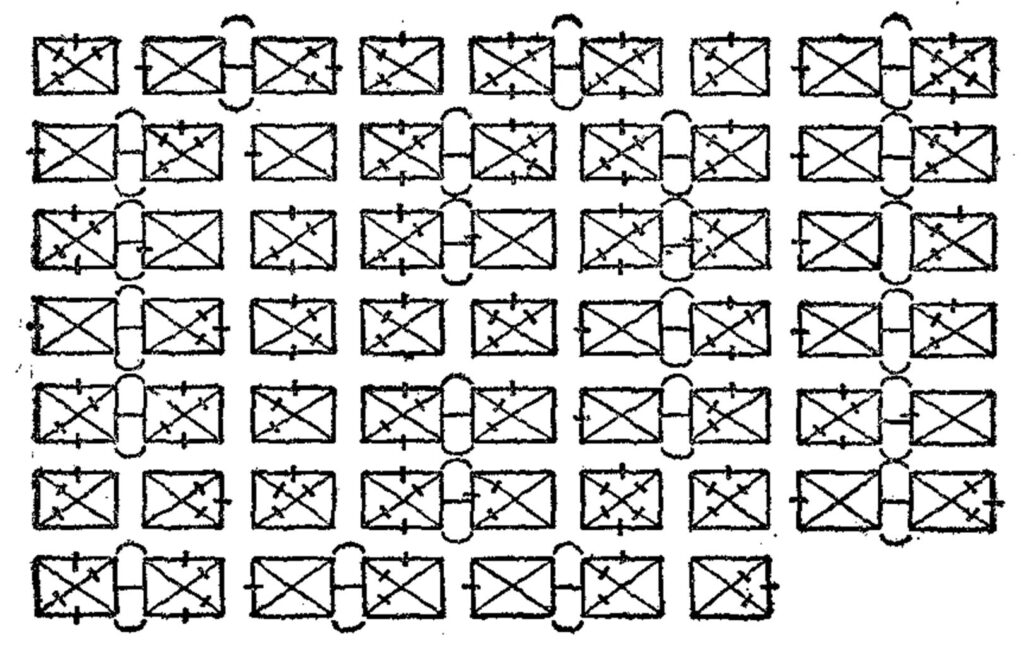
“In Robert Chambers’ 1906 novel The Tracer of Lost Persons, Mr. Keen copies the figure below from a mysterious photograph. He is trying to help Captain Harren find a young woman with whom he has become obsessed.

‘It’s the strangest cipher I ever encountered,’ he says at length. ‘The strangest I ever heard of. I have seen hundreds of ciphers—hundreds—secret codes of the State Department, secret military codes, elaborate Oriental ciphers, symbols used in commercial transactions, symbols used by criminals and every species of malefactor. And every one of them can be solved with time and patience and a little knowledge of the subject. But this … this is too simple.’

The message reveals the name of the young woman whom Captain Harren has been seeking. What is it?”

As is usual with these types of puzzles, I felt foolish that I couldn’t see the immediate, simple interpretation of the boxes—after a great deal of effort.  So I solved it using the usual cryptographic methods that rely heavily on logic and letter frequencies, though the message is a bit short for that.

Answer.

See Box Code Puzzle for solutions.

Logical Dead End

One is reduced to hysterical laughter to try to maintain a modicum of sanity.

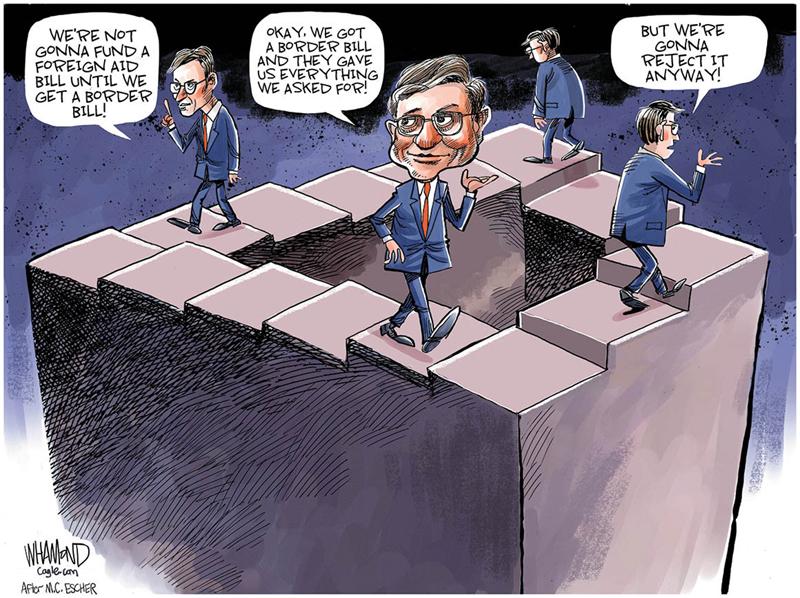
Our Senate at work: Republican Mitch McConnell said (Dec 6) “Legislation that doesn’t include policy changes to secure our borders will not pass the Senate.”  Republican Trump said (Feb 3) the Senate should not pass legislation that includes border security.  Let P be the statement “Senate legislation should include border security.” and let Q be the statement “Senate should pass legislation.”  Then we have the Republicans saying

(~P ⇒ ~Q) ˄ (P ⇒ ~Q)

Show that this is equivalent to ~Q, that is, “The Senate should not pass legislation.”—basically stop working.

It looks like the Republicans in the House are doing the same thing:

politico.com

See Logical Dead End

Old Codger Rant, with Update (4/24/2024):  Continue reading

Peirce’s Law

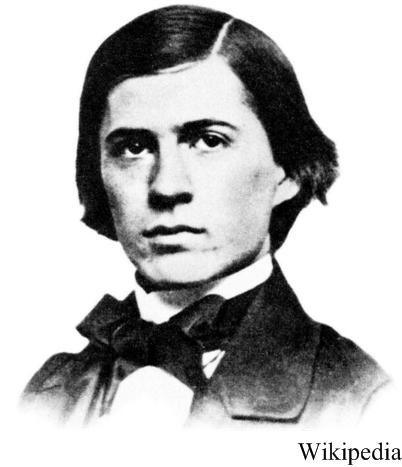
The June 2023 Carnival of Mathematics # 216 at Eddie’s Math and Calculator Blog has the rather arresting item concerning Peirce’s Law from the American logician Charles Sanders Peirce (1839 – 1914).

“Peirce’s Law:  Jon Awbrey of the Inquiry Into Inquiry blog

This article explains Pierce’s Law and provides the proof of the law.  The proof is provided in two ways:  by reason and graphically.  Simply put, for propositions P and Q, the law states:

P must be true if there exists Q such that the statement “if P then Q” is true.  In symbols:

(( P ⇒ Q) ⇒ P) ⇒ P

The law is an interesting tongue twister to say the least.”

Perhaps another way of saying it is “if the implication P ⇒ Q implies that P is true, then P must be true.”  Still, it sounds weird.

See Peirce’s Law

(Update 6/20/2023)  Appendix: Valid Argument Continue reading

Blockbusters Problem

For his Monday Puzzle in the Guardian Alex Bellos provided a seemingly impossible puzzle from the 1983 British teenager quiz show Blockbusters.

“In the much-missed student quiz show Blockbusters, teenagers would ask host Bob Holness for a letter from a hexagonal grid. How we laughed when a contestant asked for a P!  Holness would reply with a question in the following style: What P is an area of cutting edge mathematical research and also a process in the making of an espresso? The answer is the subject of today’s puzzle: percolation.

Today’s perplexing percolation poser concerns the following Blockbusters-style hexagonal grid:
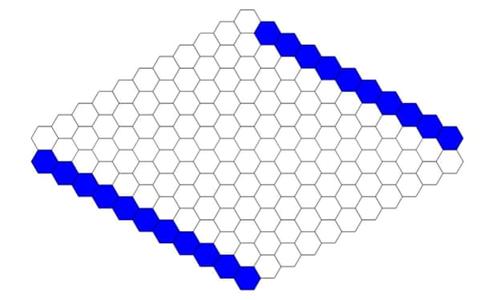
The grid above shows a 10×10 hexagonal tiling of a rhombus (i.e. a diamond shape), plus an outer row that demarcates the boundary of the rhombus. The boundary row on the top right and the bottom left are coloured blue, while the boundary row on the top left and the bottom right are white.

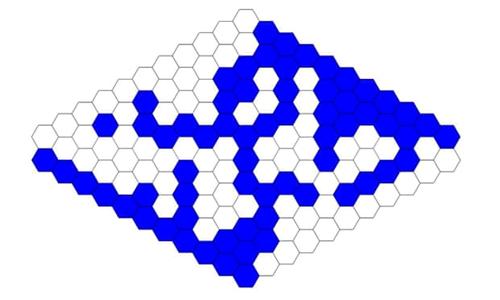
If we colour each hexagon in the rhombus either blue or white, one of two things can happen. Either there is a path of blue hexagons that connects the blue boundaries, such as here:
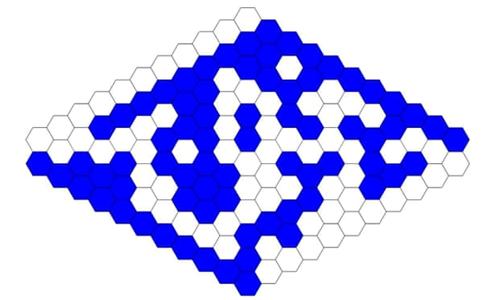
Or there is no path of blue hexagons that connects the blue boundaries, such as here:
There are 100 hexagons in the rhombus. Since each of these hexagons can be either white or blue, the total number of possible configurations of white and blue hexagons in the rhombus is 2 x 2 x … x 2 one hundred times, or 2100, which is about 1,000,000,000,000,000,000,000,000,000,000.

In how many of these configurations is there a path of blue hexagons that connects the blue boundaries?

The answer requires a simple insight. Indeed, it is the insight on which the quiz show Blockbusters relied.

For clarification: a path of hexagons means a sequence of adjacent hexagons that are the same colour.”

Answer.

See the Blockbusters Problem for solution.

“Fermat’s Last Theorem” Puzzle

Here is a mind-numbing logic puzzle from Futility Closet.

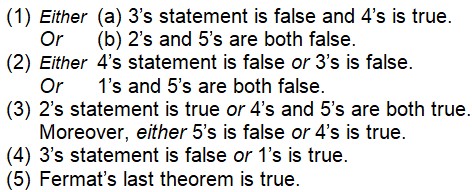
“A puzzle by H.A. Thurston, from the April 1947 issue of Eureka, the journal of recreational mathematics published at Cambridge University:

Five people make the following statements:—

Which of these statements are true and which false?  It will be found on trial that there is only one possibility.  Thus, prove or disprove Fermat’s last theorem.”

Normally I would forgo something this complicated, but I thought I would give it a try.  I was surprised that I was able to solve it, though it took some tedious work.  (Hint: truth tables.  See the “Pointing Fingers” post regarding truth tables.)

One important note.  The author is a bit cavalier about the use of “Either …, or …”.  In common parlance this means “either P is true or Q is true, but not both” (exclusive “or”: XOR), whereas in logic “or” means “either P is true or Q is true, or possibly both” (inclusive “or”: OR).  I assumed all “Either …, or …” and “or” expressions were the logical inclusive “or”, which turned out to be the case.

See the Fermat’s Last Theorem Puzzle