
 This problem from the 1987 Discover magazine’s Brain Bogglers by Michael Stueben apparently traces back to 1770, though the exact reference is not given.
“Here’s an arithmetic problem taken from a textbook published in Germany in 1770. Three people are gambling. In the first game, Player A loses to each of the others as much money as each of them had when the game started. In the next game, B loses to each of the others as much money as each had when that game began. In the third game, A and B each win from C as much money as each had at the start of that game. The players now find that each has the same sum, 24 guineas. How much money did each have when play began?”
See the 1770 Card Game Problem for solutions.
 This problem from Colin Hughes at Maths Challenge is a most surprising result that takes a bit of tinkering to solve.
 This interesting problem comes from Colin Hughes at the Maths Challenge website.
 In a June Chalkdust
  ”
”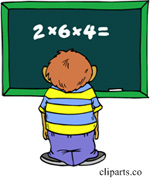 This is a tricky product problem from Alfred Posamentier which naturally has a slick solution—if you can think of it.
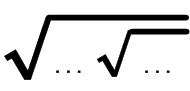 This is another UKMT Senior Challenge problem, but for the year 2005. I thought it was diabolical and hadn’t a clue how to solve it. Even after reading the solution, I don’t think I could have come up with it. I take my hat off to anyone who solves it.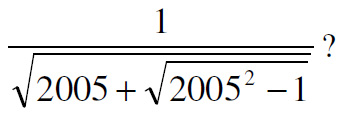

 Here is a problem from the UKMT Senior (17-18 year-old) Mathematics Challenge for 2009:


