
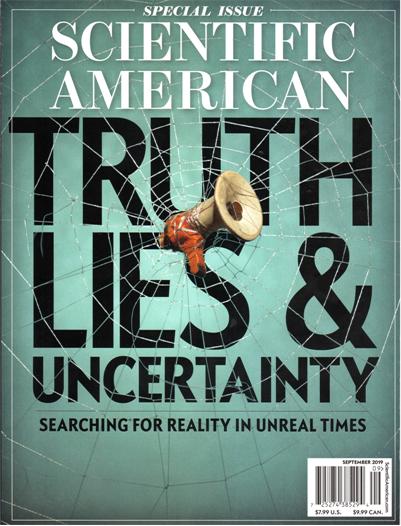
 The September 2019 Special Issue of Scientific American is a must read. Unfortunately it is behind a paywall, so you should purchase a copy at a store or digitally online. All the articles are fascinating and relevant, and address basic questions of epistemology—how do we know what we know? The first section, “Truth”, is the most pertinent to my thinking, as it covers three subjects I have been pondering for years.
Physical Reality. The first article in the section is “Virtually Reality: How close can physics bring us to a truly fundamental understanding of the world?” by George Musser. I have addressed this issue of physical reality in my article Angular Momentum, with an emphasis on the role of mathematics. Musser cites the difficulties of trying to understand quantum mechanics after almost one hundred years or the failure to marry quantum mechanics with Einstein’s theory of gravitation as possible indications that there might be limits to our human endeavor to comprehend physical reality. This frustration is not new:
Over the generations, physicists have oscillated between self-assurance and skepticism, periodically giving up on ever finding the deep structure of nature and downgrading physics to the search for scraps of useful knowledge. Pressed by his contemporaries to explain how gravity works, Isaac Newton responded: “I frame no hypotheses.”
 Here is yet another surprising result from Colin Hughes at Maths Challenge.
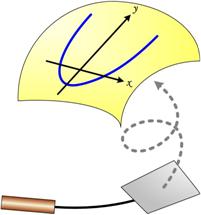 This is a stimulating problem from the UKMT Senior Math Challenge for 2017. The additional problem “for investigation” is particularly challenging. (I have edited the problem slightly for clarity.)
 There is the famous chicken and the egg problem: If a chicken and a half can lay an egg and a half in a day and a half, how many eggs can three chickens lay in three days? Fibonacci 800 years ago in his book Liber Abaci (1202 AD) did not have exactly this problem (as far as I could find), but he posed its equivalent. And most likely the problem came even earlier from the Arabs. So we can essentially claim Fibonacci (or the Arabs) as the father of the chicken and egg problem. Here are three of Fibonacci’s actual problems:
 This is another train puzzle by H. E. Dudeney. This one has some hairy arithmetic.

